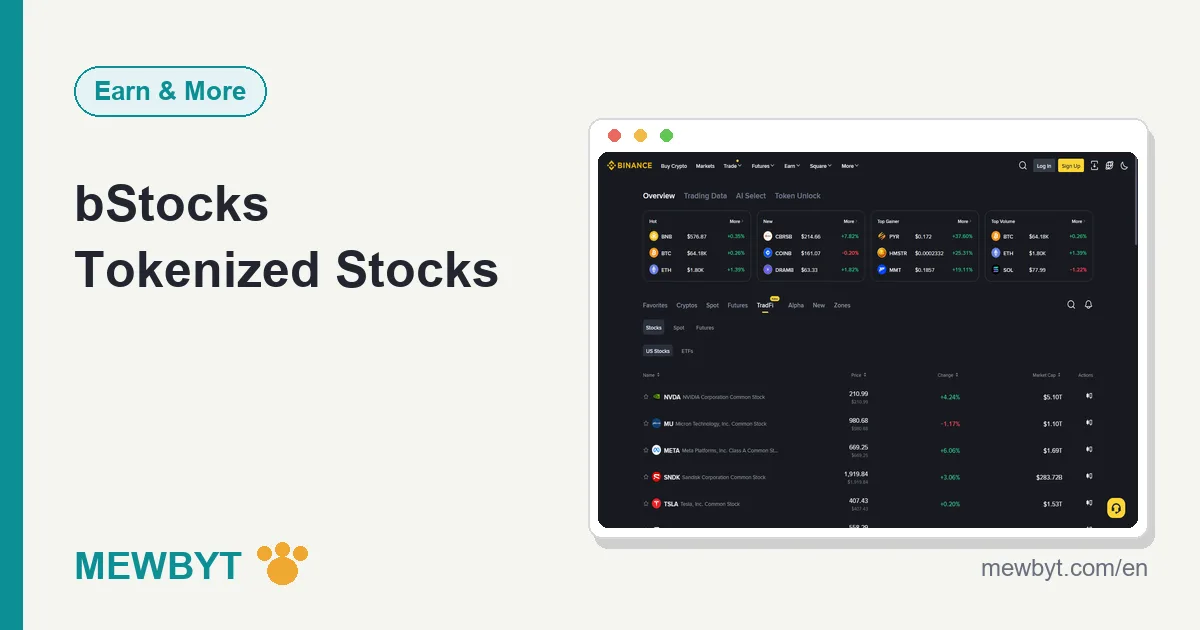
"You can buy Nvidia without a brokerage account?" In the weeks after bStocks launched, that question came up again and again. The people asking were excited, and my answer usually started by tipping half a bucket of cold water on it: what you can buy is Nvidia's price, not Nvidia's stock. The gap between those two is exactly what this article is about, and understanding it before you buy is a lot cheaper than working it out after.
First, the basics. This article pulls together how bStocks works from public information. Product details can change at any time, and the specific instruments, fees, and available regions all follow the official Binance page. Nothing here is investment advice, and least of all any hint that "US stocks are steadier than coins". Both markets have their own ways of falling.
What are bStocks?
bStocks is Binance's tokenized US stock product, launched in mid-2026: behind every bStocks token sits a real share backing it 1:1. Buy one token tied to Tesla and the issuer holds a corresponding share of Tesla on their side. The tokens are issued on-chain, and the price tracks the underlying stock.
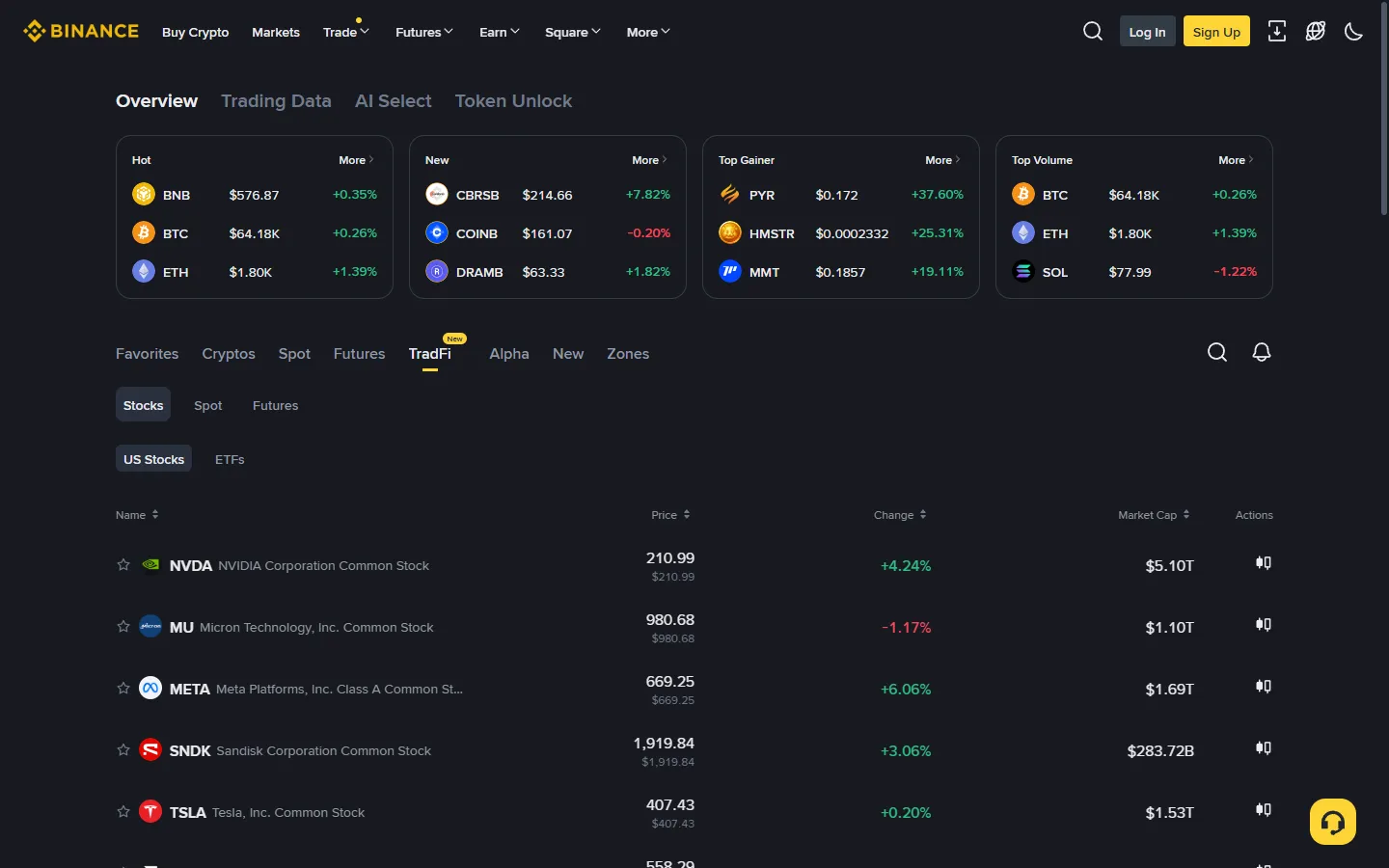
The word "tokenized" can be read like this: the value of a traditional asset is placed inside a crypto token so it can be bought and sold on a trading platform like any coin. The stock itself is held and safeguarded by the issuing and custody institutions, and what moves through your account is the token. That structure brings the convenience of a low entry point and long trading hours, and it also brings a new, "one layer removed" risk that the later sections open up.
bStocks is not a concept Binance invented. Tokenized stocks have had several rounds of attempts across the industry. But riding on Binance's user base and liquidity, it is one of the more convenient entry points to this kind of product for many users. For the product notes in the platform's own words, search bStocks on the Binance support center.
What makes them different from ordinary stocks?
Lower barrier, longer hours, and the form of a coin. Broken out, that makes four features:
- 1:1 real-share backing, convertible: the token is not a "shadow price" printed from nothing; it is backed by an equal amount of stock and supports conversion to the underlying value at that ratio, which is the essential difference from a purely synthetic asset;
- Trading after hours: the regular US market session is not friendly to Asian users, and bStocks has longer tradable hours, so news at midnight does not leave you waiting for the open. The exact schedule follows the official page;
- Low barrier, fractional amounts: you do not need to scrape together a whole share; a budget of a few dollars can open a position, handy for a beginner who wants to try a little first;
- Dividends handled as reinvestment: when the underlying stock pays out, the value does not reach you as cash but is reflected in the tokens you hold through reinvestment, effectively auto-compounding.
Of these four, the one most easily overlooked is the fourth. If you are used to collecting cash dividends, adjust the expectation: what you get is the economic value of the dividend, not a quarterly cash flow arriving in your account.
How do you buy bStocks on Binance?
There are two main routes: buying on the spot market like any coin, or using Convert to swap directly. The prerequisite is a verified Binance account in a region where the feature is supported. If you do not have one yet, start from the sign-up guide.
Taking the spot market as the example, the flow goes like this:
- Have USDT or another quote asset ready in the account; if not, see the P2P USDT buying guide;
- In the spot market, search for the bStocks pair of the instrument you want (which instruments are live follows the official page list);
- Place an order like buying a coin: a market order fills instantly, a limit order sits at the price you set; if placing orders is new to you, read Spot Trading Basics first;
- Once filled, the token lands in your Spot wallet, and you can sell it at any time.
The Convert route is simpler: pick the asset to swap out and the bStocks instrument to swap in, confirm the quote, and you are done. It suits people who do not want to study the order book, at the cost of a fill price usually less precise than placing your own order. The two routes price fees differently, so read the rate shown on the page before ordering rather than going by feel. How the various fees work is laid out in Fees Explained.
From the very first order, move a small test amount before anything larger. Confirm the instrument actually shows up for your account, place a tiny order, watch it fill and settle in your wallet, and only then size up. Because availability shifts with region and compliance, an instrument you saw last week may not be there today, so go by what the page shows right now, not by an older screenshot or a friend's account in another country.
How do they differ from owning real shares?
What you buy is price exposure to the stock, not shareholder status. You carry the ups and downs, but the rights only shareholders have, token holders mostly do not. Point by point:
| Point | bStocks token | Real share in a brokerage account |
|---|---|---|
| What you hold | An on-chain token backed 1:1 by stock | Stock registered to you (or held by the broker on your behalf) |
| Voting and shareholder rights | None; you cannot vote at shareholder meetings | Yes, exercised by holding |
| Dividends | Reflected in token value as reinvestment | Usually paid as cash to the account |
| Trading hours | Longer than the regular US session, tradable after hours | Mainly exchange hours, with limited pre and post-market |
| Structure relied on | Relies on the issuer and custodian performing | Relies on the broker and a mature securities settlement system |
| Regulatory framework | An emerging framework, treated differently across regions | Mature securities regulation, with full investor protection |
| Price vs net value | Can trade at a premium or discount | The market price itself |
The row on "structure relied on" is worth reading twice. Behind a real share is a securities registration and settlement system that has run for the better part of a century; behind bStocks is the newer chain of "Binance plus issuer plus custodian", and the credit of every link in that chain is risk you actually carry. This is not to say it will go wrong, but you should know exactly whom you are trusting more.
The "price vs net value" row is worth one more line. Because a bStocks token trades on its own order book, its price is set by supply and demand there, not stamped straight from the stock exchange. Most of the time buying and selling pressure keeps the two close, but in a thin market or a fast move they can part, and the token can sit at a premium or a discount to the share it tracks. Glance at that gap before you assume the number in front of you equals the stock's own price.
Five risks to weigh before buying
bStocks stacks the risks of both the stock world and the crypto world, and it is not "a safer way to trade stocks". Five in particular:
- Depeg and premium/discount risk: the token price should track the stock, but in extreme markets, tight liquidity, or when the conversion mechanism is obstructed, the two can drift apart, and your fill price can land well off the stock's own price;
- Liquidity risk: for a niche instrument or a quiet hour, the order book can be thin, so when you want to sell, slippage is large or you may not be able to sell at once;
- Structure risk: if the issuer or custodian runs into operational or compliance trouble, it directly affects the token's ability to be honored, a layer that does not exist when you buy a real share;
- Regulatory-change risk: tokenized securities are still new in most jurisdictions, and once regulatory attitudes turn, the product may change its rules, restrict trading, or be delisted;
- Regional availability: not every region can use it, the entry point may shift with compliance requirements, and whether you can buy and what you can buy follows the official Binance page.
The sensible place for it is as a "convenience tool" in the portfolio, not a core position. If you already hold assets on Binance and want to add a bit of US-stock exposure on the side, it is handy; if your goal is serious US-stock investing, a mature brokerage account's structure and investor protection are still the sturdier base. On top of that, tokenized assets are just as much a target for phishing and fake support, so get your account protection sorted first, in Account Security.
Frequently asked questions
Is there really stock behind bStocks?
Per the official description, every bStocks token is backed 1:1 by real shares held by the issuer, and the token can be converted to the value of the underlying stock at that ratio. But backed is not the same as holding the stock directly. The shares are registered to the issuing and custody institutions, and what you hold is the token. That structural gap is the key to understanding bStocks risk.
Do I get dividends on bStocks?
You get the economic value of the dividend, but in a different form. When the underlying stock pays a dividend, it is usually handled as reinvestment, reflected as an increase in the number or value of the tokens you hold, rather than cash landing in your account. The exact handling follows what the official Binance page states.
Can bStocks be traded 24 hours a day?
Their tradable hours run longer than the regular US market session, and you can buy and sell after hours, which is one of the selling points of tokenization. Whether it is truly around the clock, and how weekends and holidays are arranged, may vary by instrument, so go by the trading hours published on the official Binance page.
Can I buy bStocks in my region?
Not necessarily. bStocks is a product heavily shaped by regulatory attitudes, and not every region's users can access it. Some regions may not see the entry point or cannot place an order. Whether your account can buy comes down to what actually shows on the Binance page after you log in, and the official announcements.
bStocks or opening my own brokerage account, which is better?
It depends on what you want. For full shareholder rights and mature investor protection, a brokerage account is the better fit. If you already hold assets on Binance and just want low-barrier exposure to a US stock's price, bStocks is more convenient. It is one entry point alongside a brokerage account, not a replacement, and the two have different rights structures and regulatory frameworks.
So without a brokerage account, you can indeed buy Nvidia's price swings on Binance, start from a few dollars, and order at midnight, but what you buy is not that share of stock. Convenience has its price, and that price is written into structure risk and regulatory uncertainty. Think it through before you get on board, and if you are unsure, test with small money first.