The kinds of pleas for help I have seen over the years ran through my head. One person had read a verification code aloud to a "support agent" on the phone. Another scanned a QR code and then watched their wallet empty. A third lost their savings in a "signals" group led by a "mentor." These stories share one thing: the trick itself was not clever. What was clever was the timing, landing just when someone was stuck on a deposit, chasing a quick profit, or simply lonely.
Most of the damage comes from five scam families. None of them is clever; what makes them work is timing, and every one has a point where the script slips. Catching that point takes no technical skill, only having seen the script before it reaches you.
Five scam families at a glance
A quick-reference table for matching your situation to a row in a hurry; each row gets its own section below:
| Scam type | Where it slips | What to do |
|---|---|---|
| Fake support | Messages you first, manufactures urgency, asks for a code | Hang up and block; use only in-app support |
| Phishing site / fake app | Reached via a search ad or a domain off by a letter | Skip ad slots and links people send you; download only from Binance's own site |
| Fake airdrop / event | Wants you to scan-to-approve a wallet, or pay before you claim | Do not scan or approve; trust only official announcements |
| Pig butchering | An online contact pushing stock tips, an "inside info" group | Block; let no one trade on your behalf |
| Transfer scam | A P2P counterparty asks to cancel the order and trade off-platform | Stay inside the order flow the whole way |
Fake support: anyone who messages you first is not real
Binance's official support will never contact you first. Official help exists only in the live-support window inside the app and on the official site, and it does not phone you, add you on WhatsApp, or send you a Telegram message.
The script for this scam is highly fixed. You have just posted a question online, or you are stuck on a deposit or withdrawal, and a "Binance support agent" appears, saying your account is at risk, suspected of money laundering, and needs your cooperation to clear it. From there the goal is only ever one of three things: your password, your verification code, or getting you to move coins to some "safe account." Some will also ask you to share your screen "to help you operate," which is really watching what you type.
They contact you first, they hurry you, and they want a code or a transfer. Any one of the three is enough to know. Real support will never ask you for a verification code, in any situation whatsoever.
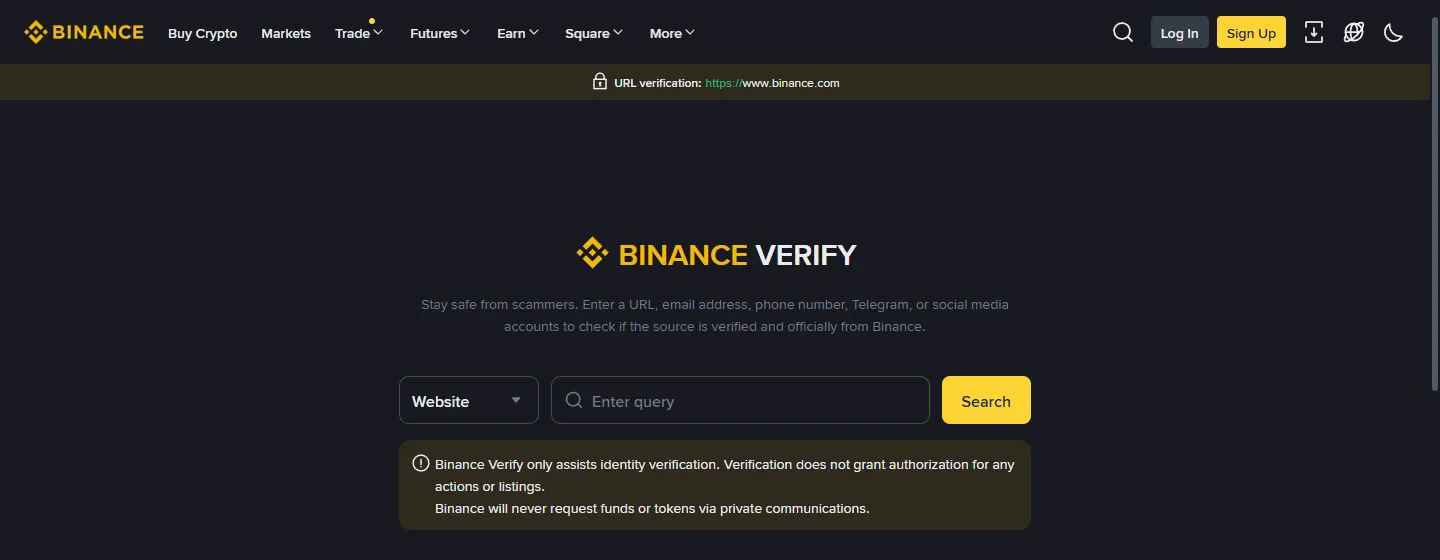
Hang up and block. If you have a genuine question, open the Binance app yourself and contact live support to check. For any account, URL, or phone number the other side leaves you, run it through the Binance official verification channel to confirm whether it is real.
Phishing sites and fake apps: ad slots and look-alike domains
Phishing sites usually reach you through one of two doors: a search-engine ad slot, and a domain spelled almost the same as the real one. The first pays to sit above the genuine site in results; the second gets by on one extra letter or a swapped suffix, invisible at a glance.
Fake apps are the mobile version of the same logic: a third-party app store, an "installer" someone sends you, a QR code of unknown origin. The interface they install looks convincingly real, and the account and password you type drop straight into the scammer's database. One variant is the "fake wallet app," where the moment you import your seed phrase, the assets change hands.
Fake sites nearly always arrive through one of three doors: a search result marked "Ad," a link someone sends you in a chat app, or a "latest download link" posted on a forum. Treat anything reached through those doors as fake until proven otherwise.
The defence is to log in through the app itself, never through a search result or a link someone sent you; download the app only through the entry on the official download page, with the exact steps in our App Download Guide. Add one more layer of insurance by setting an anti-phishing code (the method is in Account Security): an official email without your code is fake.
Fake airdrops and events: scan-to-approve and pay-to-claim
The test for this family is the simplest of all: anything that asks you to pay first or approve first before you can "claim" is fake. A real airdrop does not need you to pay a tax to release it, and a real event does not need you to approve your wallet to a stranger's contract.
Two variants come up often. The first is approval phishing: "scan to claim an airdrop" spreads on social media, and when your wallet scans the code, a signing request pops up, and if you tap confirm without reading it, what you signed away may be a token-transfer approval, after which the wallet is swept clean. The second is pay-to-release: you are told you have "won" a large amount of tokens, but to withdraw them you must first pay a "tax" or an "activation fee," and once you pay, the other side vanishes.
A reward falling out of the sky, paired with a requirement that you give something first (money, an approval, a seed phrase). When that combination appears, you can close the page. The seed phrase is the deepest line of all: anyone asking you for your seed phrase, in any situation, is a scammer, without exception.
QR codes of unknown origin stay unscanned, unfamiliar sites never see your wallet, and approval requests you do not understand go unsigned. Binance events come from only two sources: the official announcements inside the app, and the events page on the official site. Anything seen elsewhere is fake until you confirm it through an official channel.
Pig butchering: romance and signal groups, twinned
The pig-butchering script has not changed in decades; only the props have, and today the prop is cryptocurrency. Two lines run to the same destination.
The romance line: an attractive stranger you met on a dating app clicks with you, and after a few weeks starts casually showing off investment gains and warmly offering to bring you along. You are steered to a fake trading platform to deposit, and the first few small deposits "profit" and can even be withdrawn, which is the feed put out for the pig. Once you raise your stake, withdrawals suddenly "need a tax" or "the account is frozen," and you are told to send more to release it, until you wake up or run dry.
The signals line: somehow you get pulled into an "inside information" group, a "mentor" posts winning trades every day, and the screen fills with "made a fortune following the mentor," most of it planted. The arc is the same as the romance line: you are directed to a designated platform, or asked to let the "mentor" trade for you, and a little sweetness is followed by a big harvest.
Watch for four things: an online contact who talks investing soon after meeting, a "mentor" posting profit screenshots, a trading platform you have never heard of, and withdrawals that need a tax paid before they are released. Any one of them should set the alarm off.
Anyone talking investment on a dating app gets blocked, with no agonising over whether they were sincere; anyone asking to trade on your behalf, or to have you deposit to a designated platform, is refused flat; trade only inside the official app you downloaded yourself. If you are unsure whether a platform is real, run it through the framework for assessing platforms in is Binance safe.
Transfer scams: private deals that bypass escrow
The safety of P2P trading rests on platform escrow: the buyer pays, the seller releases, and it all happens inside the order flow while the platform locks the seller's coins until the trade completes. The moment you leave that flow for a private deal, the protection drops to zero.
The scammer's lines are always appealing: "cancel the order and transfer privately, the fee is lower," "the platform is slow to credit today, I will send straight to your wallet, instant," "add me on WhatsApp for a better long-term price." The instant you agree, a protected trade becomes a naked transfer. Sellers face a classic trap too: the other side sends a payment screenshot to rush you into releasing the coins, while not a cent has actually landed in your bank account.
The warning sign is any proposal to "leave the order flow." However reasonable the reason, however high the other side's rating, the moment the topic drifts toward "cancel the order," "transfer privately," or "chat somewhere else," it is a danger sign.
So stay inside the order flow the whole way; before releasing coins, log into your own bank app and confirm the money truly arrived, trusting no screenshot; if the other side defaults, use the platform's appeal process. How to pick sellers and operate safely is in Buy USDT on P2P.
Already scammed? What you can still do
The odds of recovering scammed assets are not high. On-chain transfers are irreversible, and once the scammer has the funds they usually move, split, and mix them within minutes. Even so, take the steps below:
- Preserve evidence: chat logs, transfer records, the other side's addresses and accounts, and the URLs of the fake sites, all screenshotted and archived.
- Report to the platform: if the scam involves a Binance account or a P2P order, open live chat in the app at once (support icon, then Get Support, then Unresolved; if you cannot log in, use "24/7 Chat Support" in the Help Center), send the other party's receiving address, the P2P order number and the time of the transfer, and ask to freeze their account. If the assets are still in a verified account on the platform, a freeze has a chance, but a real freeze and trace usually needs a formal request from law enforcement, so do not put off the police report.
- File a police report: take your evidence to the police even when the amount is small, because many scams are investigated jointly, and your evidence may be one piece of the picture. Where to report: in the US, the FBI's IC3 site (complaint.ic3.gov); in the UK, Report Fraud online or 0300 123 2040 (in Scotland, call 101); in Canada, the Canadian Anti-Fraud Centre on 1-888-495-8501; in Australia, ReportCyber at cyber.gov.au/report; in Singapore, the police online report, with the ScamShield helpline 1799 for advice first; in Hong Kong, the Anti-Deception Coordination Centre hotline 18222; in Taiwan, the 165 anti-fraud line. Anywhere else, use your local police's online reporting page and keep the reference number.
- Stop the bleeding to prevent a chain reaction: if you leaked a password or a verification code, change the password immediately, reset 2FA, and check the device list to shut off a second loss. If you scanned a code and signed an approval in a wallet, open revoke.cash on a computer, connect the affected wallet, revoke every contract approval you do not recognise (each one costs a small network fee), then move what is left to a new wallet.
One meta-rule that covers every variant
Scams keep reinventing their form, an airdrop today and a wealth product tomorrow, but the core is single, so the countermeasure needs only one meta-rule: any money-making opportunity that finds you first is a scam by default.
Treat it as the default value, rather than waiting for the other side to slip up before you judge. Real opportunities do not go around privately messaging strangers one by one; a stranger eager to "make you rich" is not after your happiness. And the rule harms nothing legitimate: an announcement you went to the official site to read, information you checked yourself, a decision you made after your own study, none of these count as being "found."
Beyond avoiding scams, put your account defences up too: two-factor authentication, an anti-phishing code, and a withdrawal whitelist make it hard for a scammer to succeed even with some of your information, and the setup is in Binance account security, done in twenty minutes. For any channel you are unsure of, check it on the official verification channel before you act, a habit that on its own blocks most scams.
Frequently asked questions
Will Binance support ever contact me first?
No. Binance's official support only helps through the live-support window inside the app and on the official site, and it never phones you, adds you on WhatsApp, or messages you first on Telegram. Any support agent who comes to you first can be treated straight away as fake.
How do I confirm whether a site or account is really Binance?
Use the Binance official verification channel. Paste in the suspicious URL, email, phone number, or social account, and it tells you whether it belongs to an official channel. That is far more reliable than eyeballing the domain, so check anything you are unsure about.
Can coins lost to a scam be recovered?
Honestly, the odds are low. On-chain transfers are irreversible, and scammers usually move and mix the assets fast. It is still worth keeping evidence, reporting to the platform, and filing a police report, and if the assets flowed into a verified exchange account, a freeze and trace have some chance. Be wary of any paid recovery service, which is essentially a second scam.
How do I tell a fake Binance app from the real one?
The most reliable method is to trust only the download source: enter the app store or get the installer from the download page on the Binance official site, do not tap search-engine ad slots, and do not scan QR codes of unknown origin. After installing, check the developer details, and set an anti-phishing code before you log in.
On P2P, can I cancel the order and transfer privately if asked?
No, that is a classic scam opener. Cancel the order and transfer afterward, and the trade leaves platform escrow, so once the coins or money are handed over and the other side disappears, you have no protection. Whatever reason they give, a lower fee or faster crediting, complete the trade inside the order flow.
The people who read an article like this carefully tend to be cautious already, while the ones who need it most are in some "rewards group" right now, certain they have met a benefactor. If this piece helped you, forward it to the friend or family member who recently started chatting with you about "investment opportunities," because heading off one is one saved. If you meet a new trick this article did not cover, write to mewbyt@mewbyt.com and we will add it.