My first impression of Launchpool came from one line in a chat group: "Drop your BNB in, collect free new coins, only a fool sits it out." I believed the first half and skipped a more basic question: the BNB I bought to join the activity was itself a position. Later, one BNB pullback wiped out more than all the new coins I had mined across several rounds combined. Launchpool is genuinely well designed, but the phrase "free money" does not fit it. This piece walks through the mechanism, the steps, and the cost that is easy to overlook, in order.
What is Launchpool, in one line?
Launchpool is Binance's new-token distribution activity: you stake a designated asset such as BNB or FDUSD into an activity pool, and share the new project's tokens the project puts up, pro-rata to your slice of the whole pool. When the activity ends, your staked principal comes back untouched. The number of your coins never drops from start to finish; what is added is the new tokens you were allotted.
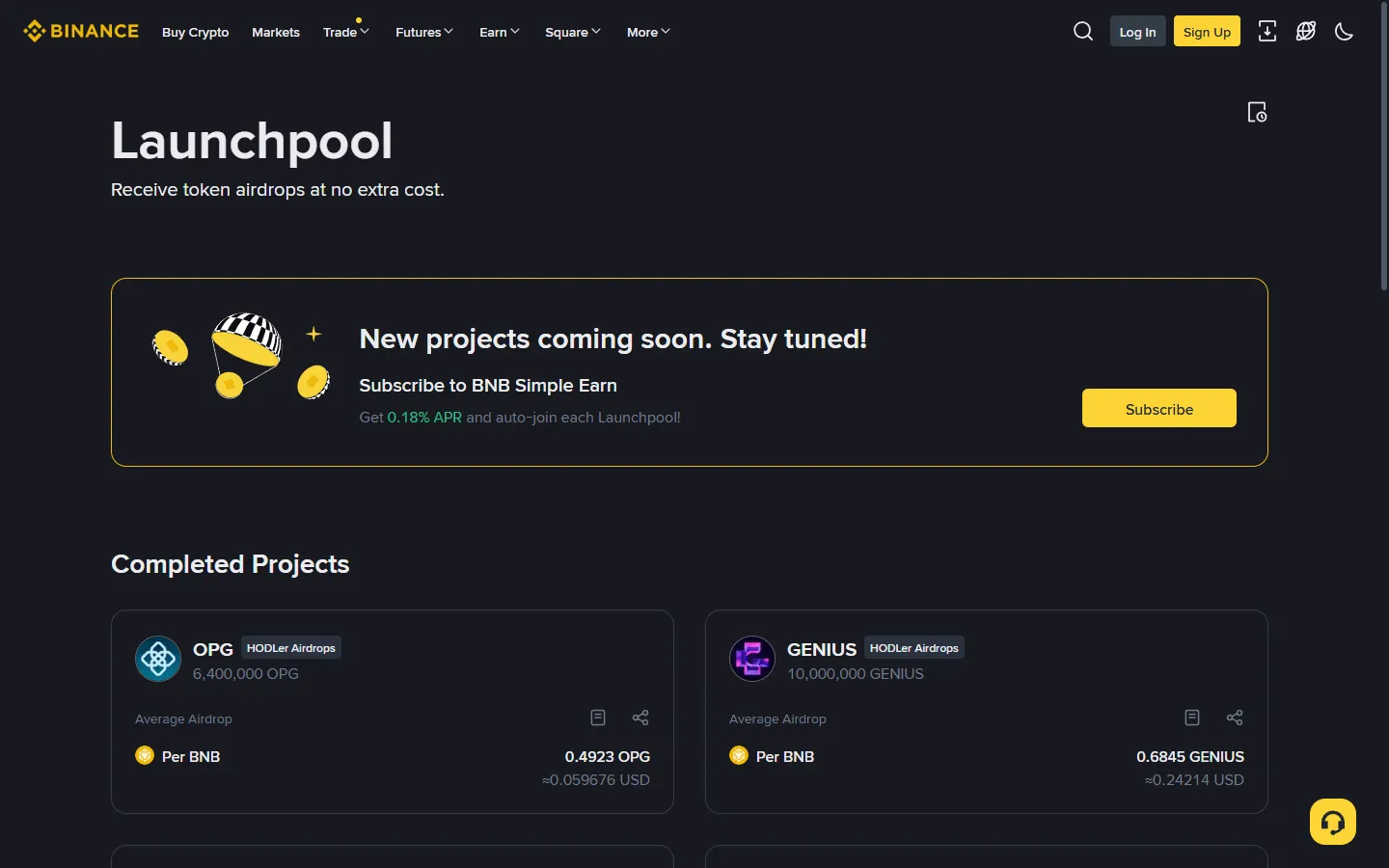
A few basic settings: which project each round mines, which pools open, and how many days it runs are all posted on the activity page, generally lasting from a few days to a few weeks; the split is settled hourly or daily, claimed as you go or all at once at the end, per that round's page. During staking you can usually exit at any time, after which you stop taking part in the rest of the split.
In plain terms, this is a targeted airdrop where holders claim new tokens on the strength of their position. What you put in is not money; it is the time and opportunity cost of your holding. As for why such a good thing exists, the rewards section spells it out. The official rules for each round are on the Binance support center.
How do you join, from setup to claiming?
The flow itself runs in five steps, with nothing technical about it:
- Prepare the account: you need a verified Binance account. If you do not have one, open it through the the sign-up guide;
- Prepare the assets: hold BNB (or the other asset supported that round) in the account. If you do not, buy some first, with routes in how to buy crypto on Binance;
- Open the activity page: search Launchpool in the app, or enter from the home-screen activity link, and choose the current project and the pool you want to join;
- Stake: enter the amount and confirm, the assets move from your Spot wallet into the activity pool, and your share starts accruing pro-rata;
- Claim and exit: claim your allotted new tokens per the activity rules; when the activity ends or you exit early, the principal returns to your Spot wallet and the new tokens are yours to handle.
BNB sitting in Simple Earn Flexible can, in some rounds, join the Launchpool calculation automatically, no manual shuffling needed. Whether that applies follows the notes for that round, so do not assume it.
Where do the rewards come from? What is in it for the project?
These "free" new tokens are the project's marketing budget. A new project puts up a small slice of its token supply for Binance to distribute, and gets three things back: concentrated exposure before listing, a batch of ready-made initial holders, and the position of listing on Binance itself. It is the same logic as a company doing a roadshow and buying ads before going public, except it pays in its own tokens rather than cash.
Once you know where the money comes from, two things follow. One, Launchpool is not charity: you are a "reached user" in the project's marketing funnel, padding its buzz and holder count while you claim tokens. Two, the reward's ceiling is fixed by that budget, since how many tokens the project puts up and what they are worth after listing decide the total pie all participants split. Pie does fall from the sky, but its size was set in advance by someone else.
How much do you actually get, and why can't it be predicted?
It cannot be predicted, and do not trust anyone who says otherwise. Your actual reward is set by two variables, and both are unknowns at the time you stake:
- Your slice of the whole pool: the split is pro-rata, and the pool's total stake keeps changing from the start of mining to the end, as big holders come and go and your share dilutes or recovers along with it;
- The new token's price after listing: however many tokens you are allotted, what they are worth only becomes clear once trading begins, and the swings in the early hours of a new listing are often violent.
Run a purely illustrative set of numbers: say a round distributes 10 million new tokens and your staked BNB is 0.001% of the whole pool, so you get roughly 100 tokens; whether those 100 are worth a meal or a phone depends on the listing price. Those figures are an illustration and match no real round. The activity page often shows an "estimated APR", a snapshot back-calculated from the current pool size and some reference price; the moment the pool or price moves, it is void. Treat it as a reference, not a promise.
Why is "free yield, zero risk" an illusion?
"Principal returned untouched" refers to the number of coins, not their value. Your staked BNB comes back to you not a single coin short, but over those weeks BNB's price rises and falls all the same, and Launchpool shields none of that swing.
Back to the accounting. Say you hold the equivalent of 10,000 in local currency of BNB and join a round, during which BNB pulls back 10%, so the position is down 1,000 on paper; the new tokens you are allotted may be worth only tens to a few hundred (an illustration; rounds vary enormously). The mining reward is loose change, the position swing is the main body. If you already hold BNB long term, you carry that swing anyway and joining is money on the side; but buy BNB specifically to mine and you have opened a BNB long position to chase a much smaller airdrop, an account that rarely adds up.
Two more points not to overlook: hold the new token after you receive it and you have opened another high-volatility position, and an early-listing price that fades is not rare; a stablecoin pool such as FDUSD sidesteps BNB's swings, but stablecoins themselves have depegged before. To gauge how much position you can stomach, run it through the Position Size Calculator first.
How does it differ from Simple Earn?
Simple Earn is "collect interest", Launchpool is "gamble on new tokens". The act of putting coins in looks alike, but the accounting is two separate books. Point by point:
| Point | Launchpool | Simple Earn |
|---|---|---|
| What the reward is | A new project's tokens | Interest, usually paid in the coin you deposited |
| Where it comes from | The project's issuance marketing budget | A share of the platform's lending and similar activity |
| Reward certainty | Low, depends on pool share and new-token price | Relatively predictable, though the rate floats |
| Term | Follows the activity cycle, on and off | A standing product, Flexible and Locked available long term |
| Coins supported | Usually limited to BNB and designated assets | Hundreds of coins |
| Who it suits | People who already hold BNB | People with idle coins who want interest |
The two do not clash; many BNB holders keep coins in Simple Earn Flexible for interest, move them to mining when an activity runs, and move them back afterwards. The full playbook and risk account for Simple Earn are in the Binance Simple Earn guide; if tokenized US stocks interest you, look at what bStocks are too.
Frequently asked questions
Do I need a lot of BNB to join Launchpool?
There is no hard threshold; a very small amount can take part, only the new tokens you receive are pro-rata, so a small stake earns a small share. Do not add to your BNB just to mine more. The mining reward is the small part; BNB's own price swings are the big part, so your position size should be decided by your view on BNB, not by the promotion.
Can I withdraw my BNB anytime during a Launchpool?
Usually yes. Launchpool staking typically supports redemption at any time; once you pull out you stop taking part in the rest of the split, and the new tokens already allotted are yours. The exact redemption rules follow the notes on that round's activity page.
Should I sell the mined tokens right away?
There is no standard answer. Volatility right after listing is extreme, and many participants sell on receipt to lock in what they have; others who like the project choose to hold. The only certainty is this: hold without selling and you carry the full price swing of that new token, which is a separate investment decision, not the default continuation of mining.
Can I join Launchpool without BNB?
Some rounds open a stablecoin pool such as FDUSD, so you can take part with a stablecoin instead of BNB, and which pools open follows that round's activity page. A stablecoin pool sidesteps BNB's price swings, and its pool share and reward structure differ too, so run the two sides as separate accounts.
Launchpool is a side perk for BNB holders, not a gold mine to make a special trip for. The reason to hold should stand on its own, with the activity only the icing; read that in reverse and it still holds: if a BNB drop would keep you up at night, no number of mining rounds makes it back.