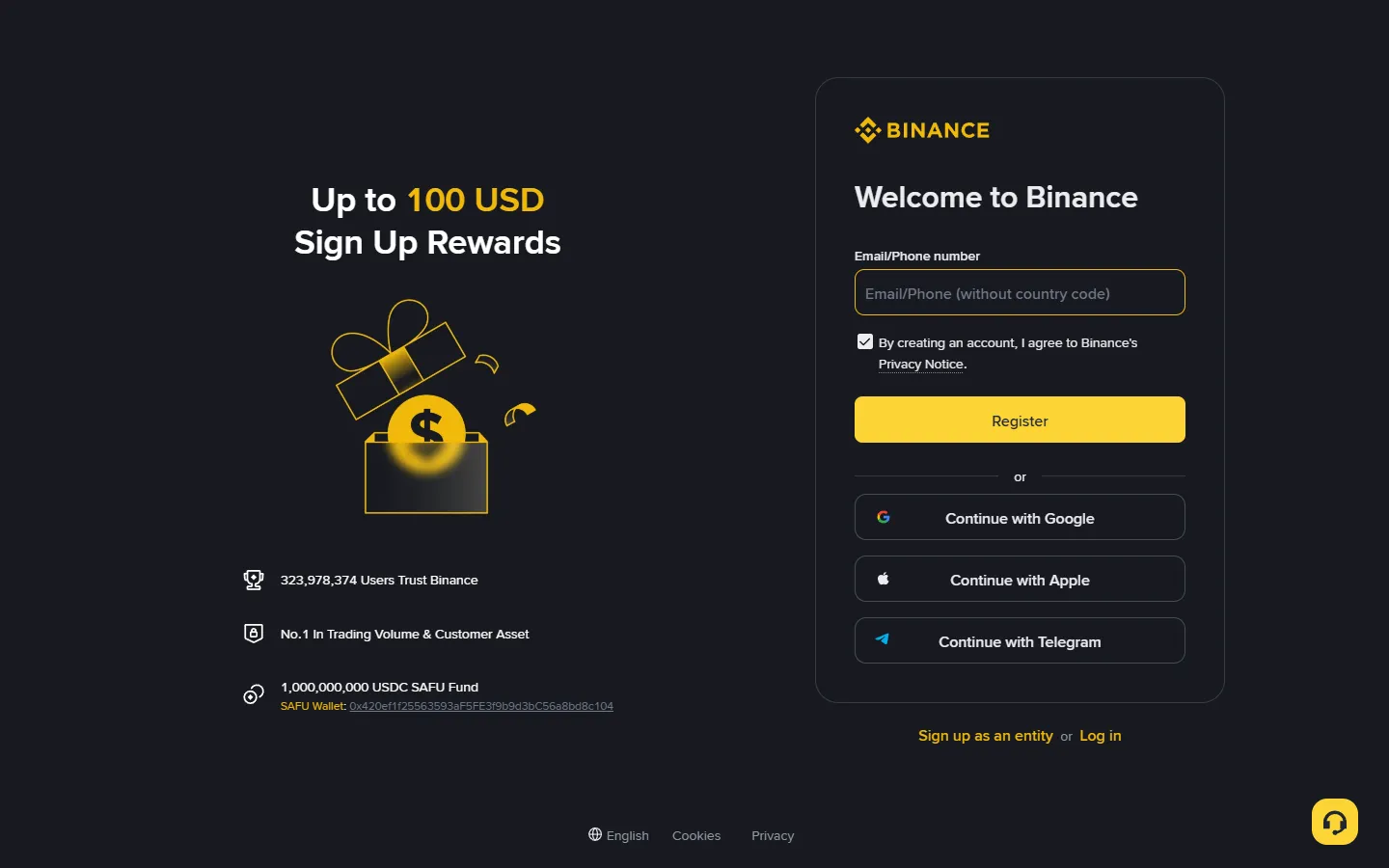
When you sign up for Binance, the registration form hides a collapsed field labelled "Referral code (optional)". Because it says optional, plenty of people skip it, then feel the regret the first time they look closely at a fee bill. Let us put the three things that matter most right at the top: enter the referral code BN03688 during sign-up and your trading fees get a 20% discount (actual rate as shown on the Binance sign-up page and subject to change); the discount costs you nothing, so skipping it only means paying full price; and once the account exists, there is no way to add a code after the fact.
This article walks through the whole thing end to end: what a referral code is, where the 20% discount comes from, how to enter it, where to confirm it took effect, how much it saves at real trading volumes, whether it stacks with the BNB fee discount, and the handful of myths and scams that trip people up. One thing to say plainly before we start: BN03688 is our own referral code, and when you register through it we earn a commission from Binance. Because that relationship exists, we owe you a clear account of the mechanics so you can judge for yourself whether it is worth using, rather than entering a code blindly. The full statement is on our affiliate disclosure page.
What is a Binance referral code?
A Binance referral code is a short string, usually letters and numbers, that Binance's official referral program uses to record who invited you. Enter someone's code at sign-up and a link forms between you and that person: you get a fee discount, they get a rebate. The link is set once, lasts for the life of the account, and needs nothing further from you afterwards.
A few basic facts, each one worth remembering on its own:
- The code only does its work at the moment of sign-up. Once the account is created the relationship is fixed, so it cannot be changed and it cannot be added later.
- The code decides the rebate relationship and nothing about account access. It is not a password and not a verification code, so someone knowing whose code you used creates no security risk at all.
- Any verified Binance user can generate a personal referral code in their account. That is why the codes you see online look so varied, even though the same mechanism sits behind all of them.
- Entering a code never makes your fees higher. It only applies a discount on top of the standard rate. This is the least intuitive part of the whole system, and the part most worth stating out loud.
A referral code is closer to the sign-in sheet at a shop entrance than to a membership card or a prepaid voucher. Behind it is a public marketing program: Binance's official help center has a dedicated page for the referral program, with the rules, the rates, and the settlement method all written out. When something is unclear, you can always search the official Binance help center for "referral" and read the source text rather than taking any third party's summary, ours included, on trust.
One distinction clears up a lot of confusion: a referral code and a referral link are the same thing wearing two outfits. The code is the short string you type; the link is a sign-up URL with that string tucked into its ref parameter, so opening the link just fills the code in for you. A QR code is the link again, this time as an image a phone camera can read. Three formats, one Referral ID underneath. As for whose code to trust, the honest answer is that the code itself cannot hurt you, so the thing to vet is not the code but the page it sends you to. A real code drops you on Binance's own domain with the field pre-filled and nothing else asked of you. A code that comes bundled with a request to install some other app, join a chat group, or hand over a deposit is not a referral code doing its job; it is bait, and the code is just the wrapping.
Where does the 20% discount come from?
The discount money comes from the customer-acquisition budget Binance was always going to spend. It moves through the commission split in the official referral program, settles automatically inside Binance's own system, and never passes through a third party's hands.
Break the whole chain into steps and there are four:
- You complete a trade on Binance and pay a fee at the standard rate.
- Binance passes a share of that fee to your inviter under the referral program's rules. This share is the rebate.
- In their own dashboard, the inviter can set how much of that rebate to hand back to you, up to the full amount. For you it shows up as a fee discount or a periodic rebate.
- The "20%" you see on the sign-up page is the portion your inviter passes back to you. The exact number is whatever the page displays the moment you register.
Why is Binance willing to spend this? The logic is the same as an online store handing out referral coupons: rather than paying the whole advertising budget to ad networks, it is cheaper and more measurable to share part of it with the existing users who bring in real new users. To the platform it is an acquisition cost, to the inviter it is promotional income, and to you it is a rate discount. Three sides, three things they each want. That is also why we are comfortable saying it is not some grey-market trick: the entire mechanism is a documented product feature on Binance's own site, explained openly in the help center, not a loophole anyone slipped through.
Two limits are worth stating up front. The first is that the rebate pool has a ceiling: the share an inviter can pass back to a new user is a band the platform sets, not an amount they can invent at will. Anything promising far more than that framework deserves immediate suspicion, and the myths section below goes into why. The second is that the rate can shift with official promotions. Everywhere on this site that we mention 20%, we attach "as shown on the sign-up page" for a reason. That note is not boilerplate cover: the number really is whatever the page displays the moment you register.
One more worry deserves a direct answer: could the platform quietly nudge up the fee rate for coded users to fund the rebate? It does not, and you can check this yourself. Binance's standard fee schedule is public and uniform, visible to everyone on the official fees page. A coded account gets a discount on that same public schedule, not a separate, worse one. At any time you can compare the published numbers against what your account actually charges, and when the two line up, the books behind this mechanism are clean.
It also helps to see where this sits in the wider world of online marketing, because that is what makes it durable rather than a passing gimmick. Almost every large consumer platform runs some version of refer-a-friend: a bank that pays you for bringing a new customer, a ride app that splits a credit between inviter and invitee, a software tool that shaves a month off both subscriptions. Binance's referral program is the same shape, tuned for a trading platform where the recurring cost is the fee rather than a monthly bill. Because the payout is funded by fees the platform only collects when you actually trade, the incentive lines up in a healthy direction: the platform earns when you use it, the inviter earns a slice of that, and you keep a discount for as long as the account exists. Nobody is paid for you signing up and doing nothing, which is why the numbers stay sustainable and the program does not quietly disappear the way a one-off bonus would.
How do you apply the code at sign-up? Three ways
You can type the code by hand, click a link that already carries it, or scan an invite QR code. All three do exactly the same thing, attaching BN03688 to your new account, so pick whichever is easiest.
| Method | How it works | Easy to get wrong |
|---|---|---|
| Type it by hand | Expand the "Referral code (optional)" field on the sign-up form and enter BN03688 | Misreading similar characters (the digit 0 and letter O, the digit 1 and letter l); check it once more before submitting |
| Click a coded link | Open the page through a sign-up link that carries the referral parameter, and the code fills itself in | Almost nothing goes wrong, as long as the link comes from a source you trust |
| Scan a QR code | Scan an invite QR code to reach the sign-up page; it is just the link in image form | Confirm you land on Binance's official domain before entering any details |
The method least likely to go wrong is the second. Open the page through the coded sign-up link and the referral field is filled with BN03688 for you, leaving only your email and password to enter, which means one fewer manual step and one fewer chance to leave it out. Readers who prefer to type the code by hand should note a small detail: the app and the web put the referral field in slightly different places, and some versions bury it so deep you have to tap the little arrow on "Referral code (optional)" before it appears. If you cannot find the entry, our Binance sign-up guide shows where every step lives.
Whether you click a link or scan a code, do not skip one preliminary step: before entering any details, glance at the browser address bar and confirm you have landed on the sign-up page of Binance's official domain. What phishing sites love to do is clone the sign-up page pixel for pixel, then dangle an "exclusive high-value code" to reel people in. The page can be faked, but the domain cannot. If the address bar does not match the official domain, do not type a single character, just close the tab.
Whichever method you use, take two seconds before submitting to confirm the referral field actually holds something and that the characters match BN03688. Those two seconds guard against a mistake that can never be undone. We will repeat this once more before the article ends, because it genuinely matters that much.
Two edge cases are worth a quick note. If the referral field looks greyed out or refuses to accept input, you almost always arrived through a link that already carried a code, and the app has locked the field to protect that value, so there is nothing to fix. If instead you see a code you did not choose sitting in the field, that is the sign of a link from someone else, and you can clear it and type BN03688 in its place before submitting. And if you are registering on the app after tapping a link in a browser, check that the app actually opened on the sign-up screen with the code carried across, because a handful of older phones drop the parameter in the hand-off from browser to app. When in doubt, the surest route is to type the eight characters yourself and read them back once.
Where do you confirm the code took effect?
Open the Binance app, go to "Account", and find the "Referral" page (some versions call it "Referral Rewards"). If you can see an invite relationship or a rebate status there, the code is active.
Walk the path once:
- Open the Binance app and go to the "Account" page.
- Find the "Referral" entry in the feature list. On the web it sits in the dropdown under your profile icon at the top right.
- Open it and check your invited status: an active account shows the binding relationship and a link to its fee-rebate records.
Once it is active there is nothing more to do. The discount settles automatically, returning on each trade under the program's rules, with no manual claim and no "activation" step. The rebate records build up slowly as you trade, so an occasional glance is all it takes.
A word on timing, because it confuses a lot of people. Newly registered users often rush to the referral page, find it empty, and assume the code failed. Do not panic. The rebate follows your trading, so with no trades there are no rebate records, and an empty page is normal. Once you have traded, the rebate does not appear instantly trade by trade either; it settles into the account in batches on a cycle, with the exact timing set out on the official page. What tells you the code worked is whether the binding relationship is there, not whether a rebate figure has moved yet.
While you are on that page, it is worth understanding what it is actually showing, since the layout trips people up. The referral or rewards section is built for people who invite others, so most of what you see is geared toward sharing your own code and tracking people you bring in. The part that matters to you as an invitee is smaller and quieter: a line or a card confirming who invited you, sometimes labelled as your referrer or inviter, alongside the fee benefit tied to that relationship. You will not necessarily see a big banner announcing the discount. A modest confirmation that the relationship exists is enough, because the fee reduction rides on that relationship automatically from then on.
If that page is genuinely bare, with no invite relationship at all, you can be fairly sure the code was not entered at sign-up. Perhaps the field was blank at the time, or perhaps a mistyped character failed the check. That, unfortunately, is exactly the problem the next section deals with.
Copy the referral code BN03688, or tap the link below to register on Binance with it filled in for you, at the fee discount shown on the sign-up page.
*Actual rate as shown on the Binance sign-up page and subject to change. See the affiliate disclosure.
Already registered without a code? What now?
Here is the conclusion, unwelcome as it is: there is no official way to add a referral code to an account that already exists. Support cannot do it either, and this rule has no exceptions at Binance. The invite relationship is written in at the moment of registration, and after that nobody can change it.
The "fixes" that circulate online do not hold up, and we will pour cold water on each:
- "Ask support to bind it for you": support has no such permission, and a ticket only earns a boilerplate reply. Do not waste the time.
- "Pay someone to bind it internally": anyone charging money for this is a scammer, full stop, because the thing itself cannot be done, so taking your money is all that happens.
- "Close the account and register again": this path does technically exist, but it depends on your situation, covered below.
On closing and re-registering, there are two cases. If your account is still an empty shell, with no identity verification, no deposit, and not a single trade, then abandoning it and registering again with a different email really can bring the code along, at a cost of a few minutes. That is a personal call. But if you have already completed identity verification, the picture changes completely: one set of identity documents can be tied to only one Binance account at a time, so you would first have to finish the closure process to release your identity, then register and verify all over again. Any step in that chain can trip a risk-control review and leave the new account stuck in limbo. Risking that for a fee discount is not worth it, in our view. Treat it as tuition already paid, and put your attention on the other ways to lower the cost of every future trade, such as the BNB fee discount covered further down.
People sometimes ask whether a sub-account offers a back door here, since Binance does let a verified user open sub-accounts. It does not help for this purpose. A sub-account is created under your existing main account and inherits its referral status rather than letting you attach a fresh code, so opening one changes nothing about the discount you missed. Sub-accounts are a tool for separating funds or strategies, not a way to retrofit a referral relationship. If the main account registered without a code, its sub-accounts start from the same place. The cleaner lesson to carry forward is the one this whole article keeps circling: the single field at sign-up is the only moment this decision is live, so the payoff is in getting it right once rather than hunting for a repair afterwards.
What does 20% actually save? Let us run the numbers
How much you save depends entirely on how much you trade, and the formula is simple: money saved is roughly trade value times fee rate times 20%. The more often and the larger you trade, the more the discount is felt. Someone who buys once a year genuinely saves very little.
To put numbers on it, use Binance's base spot rate. For an ordinary user, the spot maker and taker fees sit around 0.1% per trade (as shown on Binance's fee page, checked July 2026; VIP tier and promotions all move the real number). On that basis, here is a rough sketch across three volumes, priced in US dollars:
| Monthly trade value (USD equivalent) | Estimated fee (at 0.1%) | Saved by 20% off |
|---|---|---|
| 10,000 | about 10 USD | about 2 USD |
| 100,000 | about 100 USD | about 20 USD |
| 1,000,000 | about 1,000 USD | about 200 USD |
The table is an idealized estimate. The real rate moves with your VIP tier, whether BNB fee payment is on, and the split between maker and taker orders, and the futures rate bands differ from spot, with the maker rate usually below the taker rate and the exact numbers shown on the page. To run it against your own trading habits, put your amounts and rate into our spot fee calculator and the gap before and after the discount is laid out plainly. To understand the fee structure itself, our fees explained article breaks it down in full.
To make the abstract concrete, picture a fairly typical beginner who puts about 500 USD to work each week through recurring buys and the occasional swap, landing somewhere near 2,000 USD of trading a month. At a 0.1% rate that is roughly 2 USD of fees a month, and the 20% discount trims about 0.4 USD off it. On its own that sounds trivial, and over a single month it is. Stretch the same habit across a few years, layer in the busier months when the market gets interesting and volume climbs, and the discount quietly compounds into a meaningful sum, all for a decision made once in five seconds. The maker and taker distinction matters here too: orders that add liquidity to the book (maker) are usually charged less than orders that take it (taker), so a patient trader using limit orders often pays a lower base rate before any discount even applies. The discount then works on whatever that base turns out to be.
Do not write it off just because a single trade's saving looks small. The fee is one of the few certain costs in trading: nobody can call which way the price goes, but exactly how much each trade is charged is nailed down in advance. Taking 20% off a cost that is certain is one of the few certain bargains a beginner can actually grab.
And a necessary splash of cold water: the 20% saves you on trading cost, it does not add to your returns. A fee discount should never become a reason to trade more often. Every extra trade you make weighs the fee you saved against the price-swing risk you took on, and the two are nowhere near proportional. Treat the discount as "since I was going to trade anyway, I may as well save a little", not "let me trade more to save", and your head is in the right place.
Can it stack with the BNB 25% discount?
Yes, they stack, and the order is discount first, rebate second: the BNB fee discount takes 25% off the spot fee, then the referral rebate is worked out on the reduced amount. The two do not conflict (the exact rules are as stated on Binance's official page).
Walk the order through with an example. Say a trade's standard fee works out to 100 USD:
- With BNB fee payment on, the fee is charged at 75% of that, becoming 75 USD, paid from the BNB in your account.
- The referral rebate is then figured on the 75, and at 20% that returns about 15.
- Stack the two and the trade's real fee cost is about 60, roughly 60% of the standard rate, which on a 0.1% base tier works out to an effective rate near 0.06%.
To be clear, the numbers above are an example built to show the order of the calculation, not a promise of any kind. The rate, the discount percentages, and the form the rebate takes are all as shown live on Binance's page. The BNB fee-payment switch lives in your account's fee settings, and it has one precondition: your account has to hold some BNB. Whether it is worth buying a little BNB just for the discount depends on how often you trade. Trade a lot and the discount covers the cost of holding it; trade rarely and BNB's own price swings can dwarf the fee you save, so run that sum yourself before acting.
It is also fair to ask how this interacts with Binance's VIP tiers, which lower fees as your thirty-day volume and BNB balance grow. The short version is that the referral relationship does not vanish when you climb tiers; it keeps applying its share on top of whatever base rate your tier sets. For most beginners the VIP question is academic, because the entry tiers cover ordinary volumes and you would need to trade a great deal to move up. What this means in practice is simple: you do not have to choose between chasing a VIP tier and keeping the referral discount, and you certainly do not have to trade more to reach a better rate. Let volume grow naturally if it grows at all, and take the referral discount as the piece you locked in for free at the very start.
Common myths about referral codes, pulled apart one by one
The questions below are the ones beginners tend to mix up and most need cleared up. Some are just muddled concepts, and some sit on top of real, money-losing scams. Here they are one at a time.
Do I lose out by using someone else's code?
Quite the opposite. In the rebate mechanism your cost is zero: your fee only comes out lower than it would without a code, never higher. Your assets, your data, and your account permissions have no connection to the inviter, who cannot even see whether your account exists, only an anonymous rebate record. The one who loses out is the person who registers without a code, paying the fee that could have been discounted on every identical trade, with no way to claw it back later.
Is the code sensitive? Should I keep it secret?
A referral code does not need to be kept secret. It exists to be shared, and posting it online or printing it on a card is completely fine. What you must guard is a different set of three things: your login password, your email verification code, and your two-factor code. Any "support agent", "mentor", or "staff member" who asks for those should be blocked on the spot, no exceptions. Confusing a referral code with a verification code is the most common beginner mix-up, and telling the two apart blocks a large share of scams by itself.
Someone promises 50% or even 70% cashback, far above this 20%. Can I trust it?
This is the category to be most wary of. The share the official program can pass to a new user has a clear ceiling, so a cashback rate far above the normal framework usually maps to one of a few tricks: a phishing link posing as the Binance sign-up page to steal your login details; a steer toward a fake "agent platform" where the money you deposit goes straight into someone's pocket; or a demand to settle outside the official system, with a private "manual cashback" that arrives or not at the other party's whim and leaves you no evidence if it goes wrong. The test is a single line: if the rebate does not run through Binance's own automatic settlement and has to be cashed out privately, treat it as a scam. Our scam prevention guide pulls the full range of tactics apart.
Does the code expire? Is it still valid if I enter it now?
The code itself does not expire. There is no "refreshes monthly" or "limited quantity" mechanism, and anyone telling you "the code is about to expire, register now" is most likely manufacturing urgency to rush you. What can change is the discount rate: when the platform adjusts a promotion, the number shown on the sign-up page may move, and the figure that counts is always the one on the page the moment you register. The 20% mentioned here is a common band at the time of writing, not a promise about the future.
Can I register a second account with my own code and pay myself?
No, and the risk is bigger than it looks. Almost everyone who understands the mechanism has the thought once: invite yourself, and the rebate becomes self-supplying. The problem is that Binance's terms require one main account per person, and one set of identity documents can verify only one account. A second account either fails verification or shares device and network fingerprints with the main one and gets flagged as a linked account by risk control. Once self-referral is identified the rebate is cancelled, and in serious cases the account itself can be restricted. Putting your main account on the line to save a fraction of a tenth of a percent is a losing trade any way you count it.
Can the person whose code I used see my account or my trades?
No. This is the fear that keeps some people from entering any code at all, and it is unfounded. The inviter has no window into your account: not your balance, not your positions, not your personal details, and not even a reliable way to know that a specific person signed up. What their dashboard shows is aggregate, anonymized activity, the kind of summary that lets them see rebates accruing without exposing who generated them. The relationship is one-directional and financial only. They cannot trade for you, cannot move your funds, cannot lock you out, and cannot message you through Binance. If anyone claiming to be your referrer contacts you directly and asks for account details or a payment, that is not how the program works, and it is a scam signal regardless of how they found you.
Frequently asked questions
Is the Binance referral code BN03688 still valid?
Yes. The code itself does not expire; there is no mechanism that retires it on a schedule. What can change is the fee discount rate, which is whatever the sign-up page shows at the moment you register. If the page throws no error when you enter it, and after sign-up you can see the binding relationship on the Referral page, it took effect.
Do I lose anything by using someone else's referral code?
No. Entering a code only discounts your fee below the standard rate; it never charges you a cent more, and the inviter cannot reach your account, assets, or personal information. The person who loses out is the one who registers without a code, paying full price on the same trades.
Are 'referral code', 'invite code', and 'affiliate code' the same thing?
They are different names for the same thing, the Referral ID in Binance's official referral program. Some people call it an invite code, others a referral, affiliate, or discount code, but they all go in the same field at sign-up and do exactly the same job. Do not let the names confuse you.
Can I change the referral code after my account is created?
No. The invite relationship is bound by the system at the moment of registration, and afterwards it can be neither added nor switched to another code. Support has no permission to change it either. That is why we keep repeating: confirm the code is filled in before you submit the sign-up.
Do I have to choose between the referral discount and the BNB fee discount?
No, the two stack. The order is BNB discount first, taking a percentage off the fee, then the referral rebate figured on the reduced amount, so the combined cost is lower than either one alone. For the exact percentages and wording, rely on Binance's official page.
Why is the rebate amount I see so small?
The rebate is a fraction of each fee, and the fee itself is only around a tenth of a percent of the trade value, so when your volume is modest the rebate's absolute size is naturally small. That is normal. Its value is in accumulating over the long run, and a reminder: do not trade more often just to chase the rebate, which gets the priorities backwards.
Does Binance give new users a sign-up bonus?
Sometimes. Binance runs welcome task campaigns that change by region and season, and whatever is live will show inside your account after you register. Treat any third-party page promising a fixed cash bonus as marketing bait: the referral code itself only controls the fee discount, nothing else.
To wrap up: the referral code is the lowest-cost, most certain-outcome action in the whole sign-up flow. Five seconds to type a short string buys a lasting fee discount, and that is all it is. Nothing mysterious, nothing grey. What actually deserves your attention is everything after the code goes in: identity verification, security settings, a small first test trade. We have written a guide for each step, so follow along. Anything still unclear, write to [email protected], and we read and reply to all of it.
Sources
The official word on referrals and fees: