These are the questions beginners keep running into, with duplicates merged and the rest grouped under six topics. Most answers fit in a sentence or two, with a link to the matching guide wherever something needs unpacking; anything that changes, like fees and limits, is given as checked in September 2026, with a note on where to see your own account's current figure. The six sections follow the order a new user actually meets them, from opening the account through keeping it safe, so reading straight through doubles as a rough map of the whole journey. Where an answer touches money that could be lost, we say so plainly.
Registration and account (7 questions)
The account stage packs in the most questions, and happily the answers are the most definite too: settle these seven and the account is up and running. One-off actions like entering the code, setting a password, and closing an account only have to be done right once, so read them before you start, not after you are stuck.
What do I need to register for Binance?
Three things: you must be at least 18, have a working email or phone number, and live in a country or region Binance serves. Meet those and registration itself is free and takes only a few minutes, with identity verification as the separate step that actually activates the account. The full walkthrough, including what to prepare, where the referral code goes, and how to pass verification, is in our sign-up guide.
Does it cost anything to register for Binance?
No, registration and identity verification are free from start to finish. Costs only arise once you actually use the account, through trading fees or the network fee on a withdrawal, and simply holding an empty verified account costs nothing at all. Those paid "registration services" advertised online charge for something you can finish yourself in five minutes, so there is no reason to buy one.
Do I have to enter a referral code, and what do I lose without one?
It is not mandatory, but we recommend it. Entering a referral code at sign-up takes up to about a fifth off trading fees. After sign-up, a code can only be rebound once the verified account has been dormant for 180 days, so sign-up is the moment to lock in the discount, and the mechanics are explained in the referral code breakdown.
How many Binance accounts can one person have?
One main account. A single set of identity documents can only clear verification once, and registering extras will fail verification and may trip risk controls that can drag your main account down with them. If you genuinely need separate wallets, open a sub-account in your main account's settings, where assets and permissions stay under one roof rather than scattered across duplicate logins.
What if I forget my login password?
Use the "forgot password" flow on the login page and reset it after email or phone verification. If the registered email itself is locked out, recover the email through your provider first, then come back and reset the Binance password. Note that withdrawals are paused for about 24 hours after a password reset, which is a deliberate theft-prevention measure, not a fault, and they resume on their own.
Can I close a Binance account?
Yes. Move all assets out first, then apply to delete the account in the app's account settings. Think through two things before you do it: your identity information is not released immediately after deletion, so reopening with the same identity soon after may be affected, and in most "I want to close it" situations, emptying the assets and turning off notifications is enough without deleting anything at all.
Can minors register for Binance?
No. Binance requires users to be at least 18, and verification checks the date of birth on your document, so an under-age account will not pass, while having someone else verify on your behalf breaks the terms and stores up trouble. A parent who wants to teach a child about crypto is far safer demonstrating on their own account than lending out a login.
Identity verification (6 questions)
Verification is the dividing line between "registered" and "usable," and it is where the most people get stuck. Documents, timing, and the reasons for rejection are the three things asked about most, and getting the small details right the first time saves you a second round.
Can I use Binance without identity verification?
Barely. An unverified account has deposits, trading, and withdrawals all restricted, which makes it little more than an empty shell, so complete verification soon after registering while you are still in the flow. It is also the step that lets an account be recovered if you ever lose access, so it protects you as much as it satisfies regulation. The process is in our identity verification guide.
What documents does identity verification need?
An in-date official document plus one face scan. The document can be a national ID, passport, or driver's licence, and which types you can use depends on the country or region you selected, as listed on the verification page. Shoot the document in even light with all four corners in frame, text sharp and free of glare, and take off hats and glasses for the face scan, and your pass rate on the first try goes up a lot.
How long does identity verification take to review?
Commonly a few minutes to a few hours, and Binance's Help Center says documents are usually reviewed within 48 hours. Do not resubmit repeatedly while you wait, since several submissions can actually slow the queue down. If it is rejected, the screen gives a reason, and you simply fix what it points to rather than guessing.
What if verification keeps failing?
Fix it against the stated reason, item by item: reshoot a blurry document in better light, check your name and date of birth character by character if details do not match, and try a fresh setting without a backlit window if the face match fails. If the same reason rejects you several times in a row, stop retrying mechanically and switch document type or ask support for specifics. Most rejections come down to one of three things: a blurry photo, a detail that does not match your document, or a poor environment for the face scan. The full checklist for repeated failures is in the verification guide.
Is it safe to give Binance my ID?
Verification data is stored encrypted under the platform's privacy policy, and collecting identity documents is a standard regulatory requirement for compliant exchanges worldwide, not something unique to Binance. The risk is never exactly zero, but without verification you cannot use any mainstream compliant platform at all. Submit only through the verification entry inside the app or on the official site; sending a photo of your ID to any "support agent" who messaged you is walking straight into a scam.
Can verification be transferred to someone else?
No. Identity verification is bound one-to-one to the account and cannot be transferred or reassigned, and buying, selling, or lending an account not only breaks the terms but can leave you answering for someone else's funds. Family or friends who want to use Binance should each register under their own identity, which costs nothing and keeps everyone's assets clearly their own.
Deposits and buying (7 questions)
How money comes in and how you get your first coins: this section covers a beginner's first real actions. Whichever route you take, run a small test the first time and confirm it lands before you move anything larger.
What is the easiest way to buy crypto on Binance?
For most beginners it is P2P: buy USDT from a verified merchant with your local currency, then take that USDT to the spot market to swap for other coins. It usually gives the best price because you are buying from another person rather than paying a card processor. The full flow of picking sellers and paying is in the P2P USDT guide.
Is P2P buying safe?
Trade inside the order flow, where platform escrow holds the seller's coins until the trade completes, and it is broadly safe. The risk concentrates in two things: private deals that bypass the platform, and receiving funds of dubious origin, both covered in the scam prevention guide. Run one small order your first time to learn the flow, and release coins only after you have truly confirmed the payment landed.
How little money do I need to start buying crypto?
The bar is very low. The minimum spot order on BTC/USDT is 5 USDT, and coins are bought in fractions rather than whole units, so you do not need a whole Bitcoin to own some. The exact minimum trade size is shown on the trading page and varies a little by pair.
How long does a deposit take to arrive?
It depends on the confirmation speed of the network you chose: a few minutes on fast networks, and tens of minutes when a network is slow or congested. The deposit record shows the confirmation progress, and a transfer that is sent on-chain but not yet credited is usually just short of the required confirmations, not lost. A common worry is a deposit that seems to be missing; almost always it is mid-confirmation and appears once the network catches up. The rules and how to check are in the deposit guide.
What if I picked the wrong network when depositing?
Be prepared: a cross-network deposit sent to the wrong place can be lost for good, and while some cases can be submitted as a ticket to attempt recovery, success is not guaranteed and a processing fee may apply. The most common mistake is sending TRC20 USDT to an address that only supports ERC20, so check both the address and the network every time. The only reliable fix is prevention, checking character by character and sending a small test first.
Can I buy crypto directly with a bank card?
Some regions support buying directly with a bank card or a third-party payment channel, which is the fastest route to set up and the most forgiving for a first-timer. The trade-off is a higher channel fee baked into the rate than P2P, with availability and fees shown on the payment page. On a first card purchase, watch your issuing bank's stance too, since some banks decline crypto-related charges outright.
Should a beginner's first buy be USDT or Bitcoin?
Usually USDT first. It is the main pricing and transit currency on the platform, so holding it leaves you free to decide what to buy next, and sitting in USDT while you watch is calmer than rushing to swap before you understand the market. There is no rush to hold an exotic coin on day one; USDT plus a major coin or two is plenty to learn on. To hold Bitcoin directly, the comparison of three buying methods is in how to buy Bitcoin.
Trading and fees (7 questions)
Get the costs and rules straight before you place an order, and what you save is real money. Fee figures change over time, so remembering the structure is more useful than memorising a number, and the tools linked below turn the structure into an exact figure for your own trade.
What are Binance spot trading fees?
Regular users pay 0.1% as maker or taker, 0.075% with BNB fee payment on, and a referral-code rebate takes a further slice off (checked September 2026). Your account's actual rate is shown under Fee Level on the trade page. Remember the structure, a base rate minus a few stackable discounts, and the precise number matters far less. The full breakdown of every charge, and how the discounts stack, is in Fees Explained.
How does the referral code's fee discount work?
It is a rebate mechanism: register through someone's referral code and the inviter passes part of the platform's rebate back to you, showing up as a lower baseline on your trading fees, at a rate shown on the sign-up page. It settles automatically on each trade, with nothing to tick every time you order. The mechanics are unpacked in the referral code breakdown.
What is the difference between a limit order and a market order?
A limit order sets your price and waits to fill, giving you price control but no guarantee of filling; a market order fills immediately at the current book, fast but with the final price out of your hands. We suggest a limit order for a beginner's first trade, so the fill price holds no surprises. The uses of each order type are in Spot Trading Basics.
Can I work out the fee in advance?
Yes. Use our Fee Calculator: enter the trade amount and the fee tier, and it gives you the amount deducted and what actually lands. It can also compare the difference with and without the BNB discount in one go, so you can see whether holding BNB for fees is worth it for your volume.
Can a beginner trade futures right away?
We advise against it. Futures carry built-in leverage, so a move against you past a certain point triggers liquidation and the loss of your full margin, and beginners who enter before understanding the mechanics mostly pay tuition to the market. If you must try, start with the smallest position and a low multiplier, work out the liquidation price with the Liquidation Calc before entering, and read Futures & Risks first.
Binance or OKX, which suits a beginner better?
Both are top platforms. Binance wins on liquidity, its range of coins, and the volume of learning material, while OKX has its own strengths in some features and smaller coins. If you cannot decide, open both, put a small amount on each, and compare for yourself rather than trusting a review. The item-by-item comparison is in Binance vs OKX.
What is slippage, and why does the fill price differ from what I saw?
Slippage is how far a market order's average fill price drifts from the latest quote: your order eats through the book level by level, and the larger the amount and the thinner the book, the more it drifts. Small trades in major coins feel almost no slippage, so there is no need to worry too much. To lock a price exactly, switch to a limit order.
Withdrawals and crediting (7 questions)
The loop is only complete when money comes out cleanly. Withdrawal questions cluster around timing, fees, and limits, and most "anomalies" here are really the theft-prevention system doing its job, with nothing wrong with your funds.
How long does a Binance withdrawal take to arrive?
An on-chain withdrawal usually arrives within a few minutes to an hour, depending on the network chosen and how congested it is; a P2P coin sale, by contrast, credits when the buyer pays. If a withdrawal shows as sent but has not arrived, it is normally waiting on network confirmations. The full flow is in our withdrawal guide.
How much is the withdrawal fee?
An on-chain withdrawal charges a fixed fee by coin and network, and the gap between networks can be large, and the withdrawal page shows the fee for each network as you pick it. The fee is a fixed amount per transaction, unrelated to the size, which is exactly why small withdrawals look expensive relative to the amount. Choosing a cheaper network for the same coin can save a large slice, so the practical move is to match the network to the amount and use a low-cost one for routine withdrawals.
How do I cash out to my local currency or another fiat?
The mainstream route is a P2P sale: convert to USDT first, then sell it to a merchant on the P2P market and receive your local currency. Bind your payment method in the P2P settings in advance, and once the sell order fills the money goes straight to your bound account. The steps and risk notes are in the withdrawal and cash-out guide.
If I enter the wrong withdrawal address, can I reverse it?
No. An on-chain transfer cannot be reversed once confirmed, and a wrong address is essentially a lost asset with no support desk able to claw it back. Two habits are non-negotiable: check the first and last few characters of the address before withdrawing, and send a small test amount first to any new address. Getting these right once is far cheaper than learning them the hard way.
Why has my withdrawal been suspended?
The common reasons are a recent password change, a 2FA reset, or a triggered risk-control review, after which the platform temporarily limits withdrawals for a set period. This is a theft-prevention measure that lifts automatically when the window ends, with the exact length shown on screen, so it is usually a matter of waiting rather than contacting anyone.
Can selling on P2P get my bank card frozen?
The risk exists, mainly from receiving problematic funds from a counterparty. Picking merchants with high volume, high ratings, and a long track record, and keeping full transaction records, clearly lowers the odds, though not to zero, which you should expect going in. If a card is frozen, contact your issuing bank first to learn the reason, and use your transaction records to explain the source of funds.
What can I do about the fee eating small withdrawals?
Three approaches: batch up to a certain amount before withdrawing to spread the fixed fee across more coins, choose a network with a low fee for that coin, or skip the on-chain withdrawal entirely and cash out through a P2P sale, which has a completely different cost structure. Which one wins depends on how often and how much you move.
Security and other (6 questions)
The closing six decide whether the money stays yours, so skip none of them: the little savings won in every earlier step cannot survive a single security incident. These are also the answers to act on the same day you read them.
Is Binance safe? Could it collapse or run off?
This splits into platform risk and account risk, and no one can give an absolute guarantee for either. Proof of Reserves, the SAFU fund, and the history of the regulatory settlement are all public material for judgement, laid out by the facts in our is Binance safe article. For large long-term holdings we suggest considering a self-custody cold wallet, and keeping only trading funds on any platform. The short version is that it suits trading funds well and your entire net worth poorly.
Do I really have to turn on two-factor authentication?
Yes, you do. An account without 2FA is nearly defenceless against phishing and credential stuffing, and linking an authenticator app takes only a few minutes, which makes it the highest-value line of defence there is. When you link it, write down the recovery key on paper in case you lose the phone. The full checklist is in Account Security.
A "Binance support agent" added me on WhatsApp; is that real?
Fake, without exception. Official support only operates inside the app and on the official site and never messages anyone first, so unsolicited contact is the tell by itself. You can report the account to the platform to help the next person, and the full breakdown of this tactic is in the scam prevention guide.
Does Binance have support in my language?
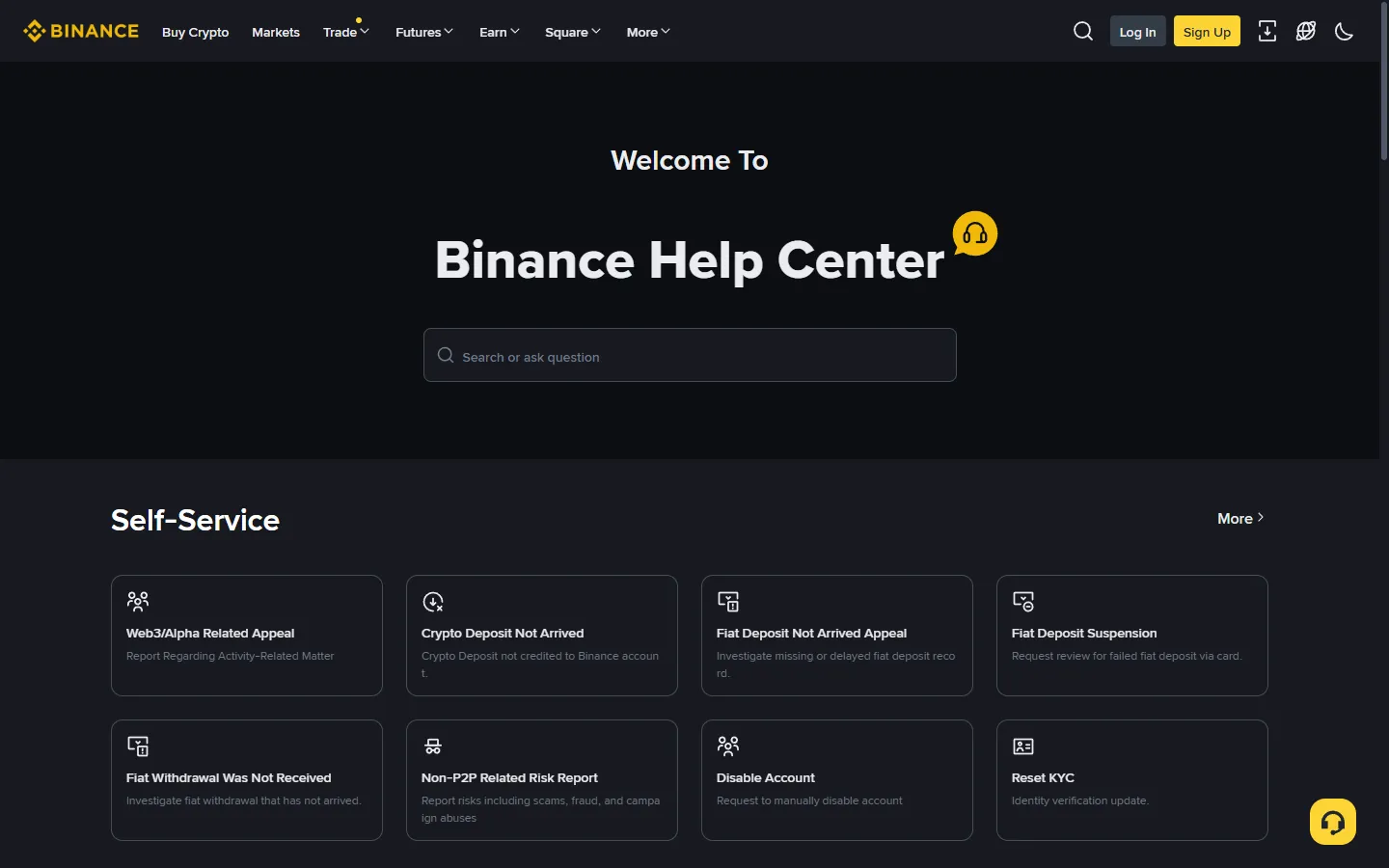
Yes. The live support inside the app and on the official site, and the Help Center, cover most routine questions in their documentation, so a quick search there often beats waiting for an agent. To stress it once more: the support entry is only the chat window inside the app and the official site, and any "support" that reaches you off-platform cannot be trusted.
Where can I learn about crypto systematically?
Among free resources, Binance Academy runs from blockchain fundamentals to trading concepts and is good for building a base, while this site's guides focus on walking through each concrete step. Using the two together, theory from one and hands-on steps from the other, works best for a beginner.
What if the Binance app will not open or loads slowly?
First switch your network, toggling between Wi-Fi and mobile data, and update the app to the latest version. If that fails, check whether your region is restricted against our Supported Countries guide, since that turns a technical problem into a policy one. For installation issues with the app itself, see the download and install guide.
If your question is not among these, send it to mewbyt@mewbyt.com; the ones that keep coming up get added. The answers above can save you detours in the mechanics. They cannot take the market risk off your hands, and every amount you put in is still yours to weigh. The guides linked throughout are the long form of these short answers.