Which one, Binance or OKX, is one of the questions beginners agonise over most. The awkward truth goes up front: both are top-tier platforms, neither is a trap, and the question has no universal answer. What it does have is a set of facts that can be laid on the table.
This site writes Binance tutorials and earns Binance referral commissions, which inevitably colors where we stand. So this article keeps the facts and our opinion clearly separated. In the factual sections the two exchanges get equal treatment and no invented flaws for either side; in the stance section we explain why we use Binance; the final judgment stays with you.
Where does each exchange come from?
Binance launched in 2017 and has spent years in the top tier of global spot trading volume, with a product range running from spot and futures through savings products and token launch programs. OKX, known as OKEx until a 2022 rebrand, is likewise a veteran top-tier platform, and its sustained investment in its Web3 wallet and on-chain ecosystem has become its clearest signature in recent years.
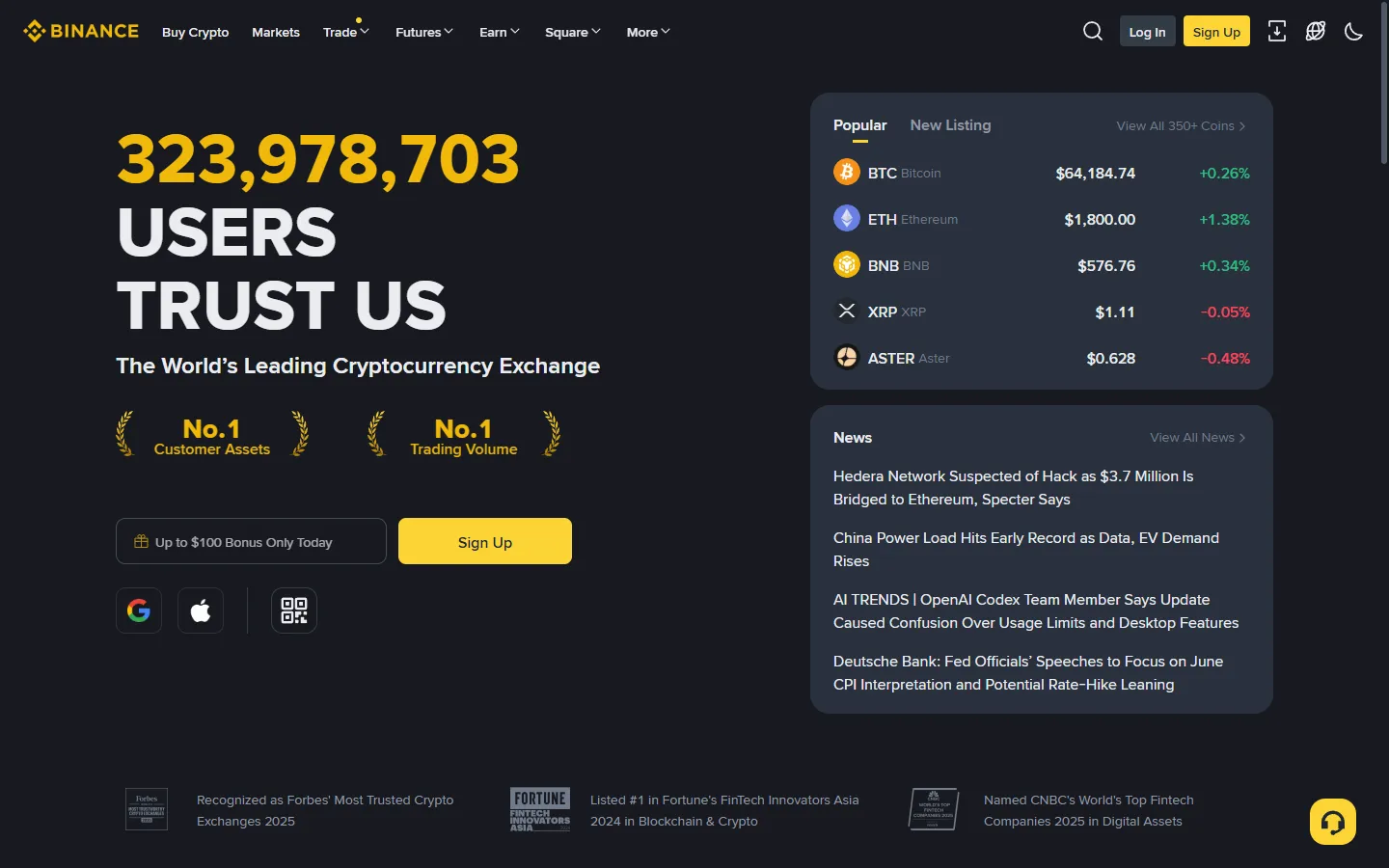
Both have traded through several full bull and bear cycles, both serve enormous user bases across many languages, and both publish proof-of-reserves reports on a regular schedule. The big-exchange-versus-small-exchange framing simply does not fit here: these are two companies of comparable weight making different bets, which is exactly why the choice between them deserves an article.
How do they line up on five counts?
Base fees sit in the same tier, coin counts are the same order of magnitude, and the real fork in the road is product focus and ecosystem direction.
| What we compared | Binance | OKX |
|---|---|---|
| Spot base fee | The 0.1% tier for regular users, with BNB discount and referral rebate | The same 0.1% tier for regular users, with OKB discount and referral rebate |
| Number of listed coins | Hundreds of trading pairs, all the majors covered | Hundreds of trading pairs, the same order of magnitude |
| Product focus | Spot depth, Simple Earn savings, Launchpool farming | Unified trading account, Web3 wallet, DEX and other on-chain doorways |
| App experience | Feature-dense, deeper menus, steeper first week | Leaner layout, often described as cleaner |
| Web3 wallet | Has one, but the center of gravity is centralized products | Built-in wallet started early; the on-chain ecosystem is the flagship |
Fee figures were checked in September 2026. The sections below expand the rows that deserve more than a table cell.
Whose fees are lower?
Prepare for an anticlimax: at the base tier there is no meaningful gap. Both charge regular spot users the 0.1% tier, both offer a platform-token discount (BNB on Binance, OKB on OKX), and both run referral rebate programs. Binance's numbers can be verified on the official fee page; for OKX's, check its own fee page directly, since we do not quote prices on the other side's behalf.
The genuine differences hide in the details: the two VIP ladders are built differently, the token discounts differ in depth and scope, and which tier your own trading pattern lands you in is what finally decides the bill. For an ordinary beginner, though, the conclusion comes out the same either way: whichever exchange you pick, attaching a referral code at sign-up and switching on the token discount matters far more than the hair's width between the two base rates. The Binance-side playbook for that is in Fees Explained.
Where do coins and product lines actually differ?
Coins first: the counts are in the same order of magnitude, several hundred each, and the majors are on both. If the coin you want is listed on both, which is overwhelmingly likely, this row decides nothing. Only hunters of very early small caps need to compare listing pages case by case, and a side note for that crowd: on either exchange, the more obscure the coin, the thinner its book and the higher its delisting risk. For a beginner, staying with the majors matters more than counting which platform lists more minnows.
Product lines are where the two part ways most visibly. Binance's strength runs down the centralized line: spot volume at the front of the industry for years, deep order books on the major pairs with relatively small slippage on large fills, a savings shelf organized into Simple Earn flexible and locked products, and Launchpool farming for new listings. The recurring theme is letting holdings earn something on the side. OKX's signature runs down the on-chain line: its built-in Web3 wallet started early, and the path from exchange account to DEXs and cross-chain bridges is unusually smooth. Users who want to step out of the exchange and onto the chain consistently rate it well, and that is a genuine OKX strength we will not talk down just because we promote Binance.
Which app is better to live with?
Both are mature, and daily use produces no hard winner. Both apps are polished, both websites are full-featured, and both localize into a long list of languages with support channels and help documentation to match. The differences are matters of design style rather than capability. The recurring user verdict is that Binance packs in more features at the cost of deeper menus, which makes the first week feel busier, while OKX reads as cleaner and more minimal. Verdicts like these carry a heavy dose of taste, so our actual advice is to install both apps and spend ten minutes tapping around each; your own hands are a more reliable reviewer than any article, including this one.
In some regions' app stores, neither app can be found by search, and installation follows each site's official instructions instead. This does not separate the two exchanges, but it is the step where first-time installers tend to stall. The Binance-side fix is in the App Download Guide; OKX documents its own process on its site.
Who suits Binance, and who suits OKX?
Sorting by need beats sorting by brand loyalty, so work backwards from what you plan to do:
- Binance fits people who: mostly buy spot and hold for the long term; want savings products and launch farming so holdings earn something on the side; care about order book depth for larger fills; or plan to learn from step-by-step tutorials, ours included, since every guide on this site is written against Binance's interface.
- OKX fits people who: are set on exploring on-chain ecosystems and want a capable Web3 wallet as the doorway; prefer a leaner interface; or already hold a Binance account and want a second platform to spread operational risk.
If you sit in both columns, or in neither, a workable tie-breaker is to follow your first concrete task. The exchange where you complete your first deposit and first purchase tends to become home base out of habit, so pick the one whose guides you will actually be following while you learn, and let the second platform wait until a real need for it shows up.
At the basic level of registering, buying coins, and storing them safely, both platforms are entirely adequate. A beginner cannot go badly wrong with either, and this decision does not deserve the anxiety it tends to attract.
One case has a ready-made answer: you live in the EU. OKX's European entity received a MiCA licence from the Malta Financial Services Authority in January 2025 and can serve EU residents; Binance has no MiCA licence and has not accepted new EU registrations since July 1, 2026. In the UK, Binance has not taken new users since October 2023 either. If you are in either place, confirm you can open an account using the supported countries guide before weighing anything else.
Our position: we mainly use Binance, and here is the interest behind that
This site runs mainly on Binance, and the reason is structural: the scenarios our tutorials keep returning to, spot, P2P, savings, launch farming, all sit on the line where Binance's shelf is most complete. And to say the rest out loud: this site carries a Binance referral code. Register through our code and Binance pays us a commission while you receive the fee discount. That is a financial motive behind our recommendation, and it is written in black and white in the Affiliate Disclosure.
So treat the factual sections on fees, coins, products, and ecosystem as spec sheets for two platforms, and make the which-one call from your own needs. If your conclusion happens to be Binance, the account-opening steps are in the sign-up guide. If your conclusion is OKX, go straight to its official site and register there. This site carries no OKX referral links and has no plans to.
Do you have to pick just one?
No. Exchange accounts are not phone contracts, and registering on both is entirely workable. Plenty of experienced users run exactly that setup: Binance handles spot and savings, OKX handles the on-chain wallet, and each does what it does best.
A second account also buys a quiet benefit: diversified platform risk. Any exchange can hit scheduled maintenance, a regional policy shift, or congestion in a violent market, and a spare working account at the critical moment is a spare path to act. The framework for judging platform risk is laid out in Is Binance Safe?, and the method transfers to any exchange unchanged. The price of the second account is doubled security upkeep: two-factor authentication and anti-phishing codes need configuring on both sides, and neglecting one of them quietly undoes the diversification.
What we would not recommend is splitting a small starting balance across two platforms on day one. Two half-learned interfaces, two sets of security settings to harden, and transfer fees on every move between them add friction without adding safety at that scale. Open the second account when the first one has a job it cannot do.
One person, one account is a rule inside each platform. You can hold one main account on Binance and one on OKX at the same time, with no conflict and no rule broken.
Frequently asked questions
Which has lower fees, Binance or OKX?
At the base tier, effectively neither: both charge regular spot users the 0.1% tier, and both offer a platform-token discount and a referral rebate. Your real cost depends on whether you switch those on and how you trade, and each exchange shows your account's current fee tier on its trade page.
Which is safer, Binance or OKX?
Both are large platforms that have operated for years, and both publish regular proof-of-reserves reports, so this one does not separate them cleanly. Every exchange still carries platform risk, though. For large long-term holdings, learn cold-wallet self-custody, and treat no exchange as a bank.
Can I register on both Binance and OKX?
Yes. They are independent platforms with separate registration and separate identity verification, and holding an account at each breaks no rule. The one-person-one-account limit applies inside a single platform, not across platforms.
Which should a beginner open first?
Start from what you plan to do first. Buying major coins, holding long term, and using savings products on the side makes Binance a solid starting point. A clear plan to explore on-chain ecosystems with a capable Web3 wallet points to OKX. One reminder: this site carries Binance referral links, so weigh that advice together with our stated position.
Why does this site only carry a Binance registration link?
Because this site writes Binance tutorials and carries Binance referral links: sign-ups through our code earn us a commission, which is a conflict of interest and is spelled out on the disclosure page. Whether OKX suits you better is yours to judge from the factual half of this article, and its official site is easy to reach directly when you need it.
As decisions go, this one is cheap to revise: both exchanges cost nothing to join, both can be tried with small amounts, and voting with your feet stays available forever. What outranks the choice by a wide margin is behaving well on whichever platform you land on: sized positions, hardened security settings, and only money you can afford to lose. The platform is secondary. The person operating it is the variable.