Our position goes at the top of the page, not in the fine print at the bottom: futures are not suitable for most beginners. That is the core conclusion of this tutorial, not a disclaimer bolted onto the end of it. As you read on, you will see how unforgiving the product's rules are to anyone without a working risk framework, and if your decision by the last paragraph is not to open a futures account, this article has done most of its job.
Why write it at all, then? Because staying away should be an informed decision too. Once you understand leverage, liquidation, and funding rates, the next time someone urges you to open a futures position to win back your losses, you will know precisely what you are being talked into, and precisely what it usually costs.
How do futures differ from spot at the core?
Spot means paying full price for coins you then own, where the worst case is the coin's price going to zero; futures means posting a margin deposit to bet on price direction, with the position magnified, shorting available, and forced liquidation waiting at a defined line. Your margin can be wiped out by a price move of only a few percent.
Unpacked, that sentence is three separate differences:
- Margin trading. Opening a futures position buys no coins at all. You post a margin deposit and control a position several times its size; profit and loss are computed on the magnified position, but the only cushion absorbing them is the margin. Every risk in the rest of this article flows from that asymmetry.
- Shorting. Spot can only profit from prices rising: buy first, sell later. Futures let you sell first and buy back later, so falls can be profitable too. One more direction to trade is also one more direction to be wrong in.
- Forced liquidation. A spot position under water can be held indefinitely; the coins remain yours while you wait. A futures position under water gets closed for you the moment the margin can no longer support it, and the loss is realized on the spot. There is no waiting it out, because the position no longer exists.
| What differs | Spot | Futures |
|---|---|---|
| What you hold | The coins themselves | A position betting on price direction |
| Maximum loss | The capital spent; total loss requires the price to hit zero | The margin; a few percent against you can consume it |
| Can you short? | No | Yes |
| Can you be liquidated? | No | Yes |
| Cost of holding | Essentially none | Funding payments, settled on a cycle |
| Who it suits | Almost everyone, beginners included | Experienced traders with a complete risk framework |
The row that matters most is maximum loss. Losing everything on spot requires the coin to fall to zero. Losing everything on futures requires one wrong direction plus a modest move. Those are risks of entirely different orders of magnitude, and the fact that the two products sit behind neighbouring buttons in the same app does not make them siblings.
It is fair to ask who the product is actually for, since the exchange plainly offers it and plenty of people use it. Futures exist for hedging existing holdings, for expressing a short view, and for traders who manage risk in a structured way at meaningful size. Those are real uses in experienced hands. None of them describes someone who opened an account last month and wants faster profits, which is precisely the person the excitement around leverage reaches most effectively.
What does 10x leverage actually mean?
Leverage is a multiplier, and the arithmetic is the whole answer: at 10x, every 1% move in the price is roughly a 10% gain or loss on your margin, so a move of about 10% against you consumes the margin entirely. That is liquidation. Nothing in that sentence is an opinion; it is multiplication.
Put numbers through it: post 1,000 USDT of margin and open a 10x long, and the notional position is 10,000 USDT. The price rises 1% and the position gains 100 USDT, a 10% return on margin. The price falls 1% and you lose 10% the same way. Somewhere around 10% down, in practice a little earlier once maintenance margin and fees are deducted, the position is force-closed and the 1,000 USDT is essentially gone.
Now add one market fact on top of the arithmetic: major coins move 5% to 10% in a single day without anyone finding it remarkable, and small caps move more. A 10x position can therefore be liquidated by a perfectly ordinary trading day. At 20x, a 5% adverse move puts you at the liquidation line, which is roughly the work of one sharp candle.
The same arithmetic run in the other direction is what makes the product tempting, and that deserves an honest hearing: at 10x, a 1% move in your favour returns 10% on margin, and the screenshots of accounts doubling in a day are not fabricated. What the screenshots leave out is survivorship. For every doubled account there is a liquidated one that posted nothing, and the arithmetic that built the first is identical to the arithmetic that emptied the second. The multiplier has no loyalty.
The least intuitive property of leverage is what it does not change: the odds of your judgment being right. It magnifies outcomes and shrinks tolerance, nothing more. Right direction, bigger win; wrong direction, faster loss; the long-run expectation is no better than before, minus extra costs. And it quietly takes one more thing from you: time. A wrong spot position can wait for you to become right eventually. A wrong leveraged position usually cannot survive long enough for eventually to arrive.
A common mistake is judging risk by the multiplier alone. Opening 10x with 100 USDT and opening 1x with 1,000 USDT are the same 1,000 USDT notional position, with the same absolute profit and loss for every move in the price. What actually sets your risk is the notional size relative to your total capital; the multiplier only sets how close the liquidation line sits to your entry. The sentence I am only using 3x, so I am safe does not parse on its own. It needs the position size attached before it means anything at all.
How does liquidation actually happen?
When losses eat your margin down below the maintenance margin requirement, the system takes over the position and closes it. That is forced liquidation, the event traders simply call getting liquidated.
Maintenance margin is the minimum margin a position must keep to stay open, set as a ratio that grows with position size. The moment your margin plus unrealized loss touches that line, liquidation executes. It does not negotiate, and it does not pause while you transfer money in, although warnings about insufficient margin usually arrive before the line does.
Mark price versus last price is the other pair of terms you cannot skip. Liquidation is judged against the mark price, a fair value blended from spot prices across several platforms, not against the last traded price on this exchange's own screen. The design exists to stop someone with modest capital from spiking a single thin order book to trigger other people's liquidations on purpose. What it means for you in practice: estimate your distance to liquidation using the mark price. A position can be gone without the last price ever printing the liquidation level, and a brief spike in the last price can leave you alive if the mark price never followed it.
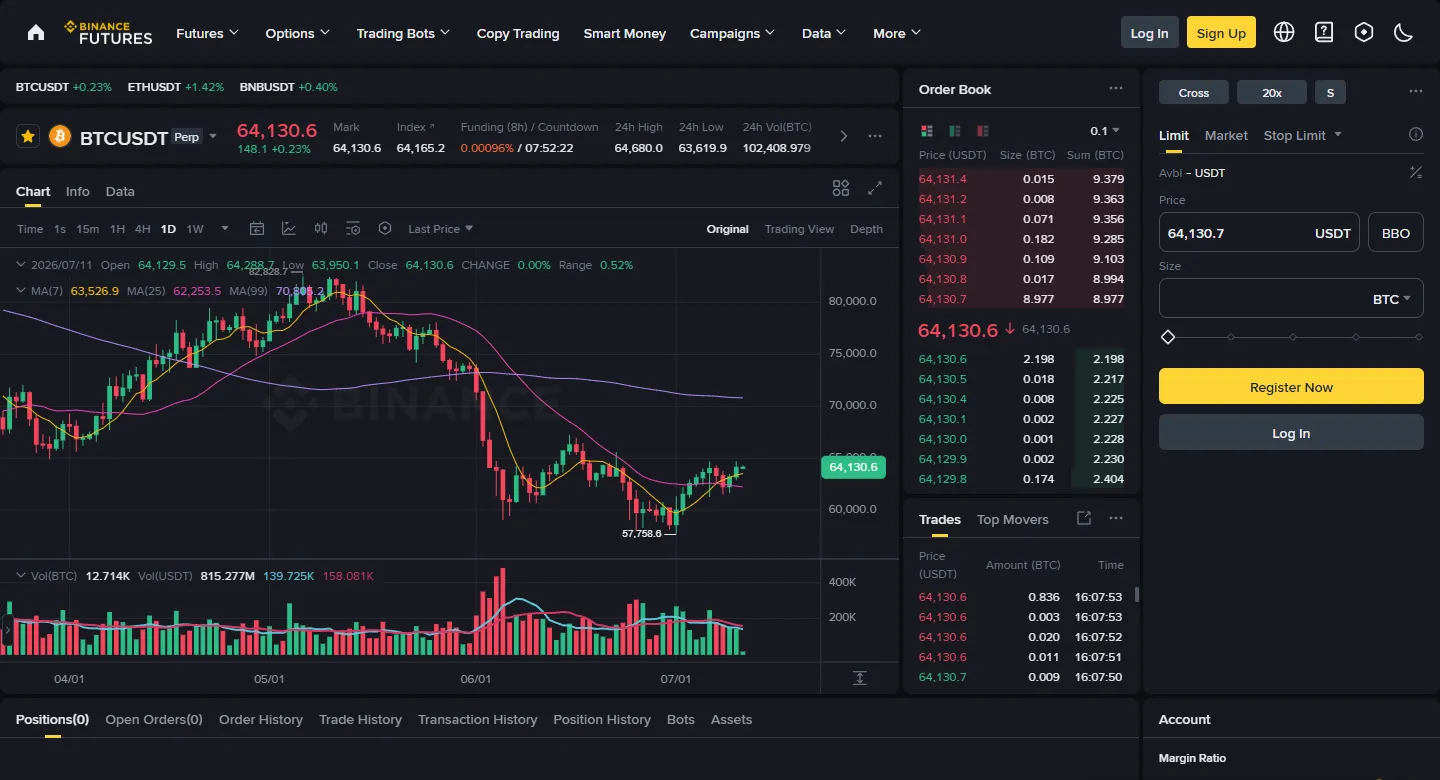
On the trading screen itself, the number to watch is the margin ratio shown in the account panel. It expresses how much of your allowance the position has already burned: the closer it climbs toward 100%, the closer liquidation stands. Binance also sends margin call warnings by notification and email as the ratio deteriorates, but treat those as fire alarms, not as a plan. If a warning is what tells you a position is in trouble, the sizing was wrong at the entry.
After liquidation, an isolated position's margin is essentially zero. In extreme conditions, if the forced close fills at a worse price than the bankruptcy price, the shortfall in between is handled by mechanisms such as the platform's insurance fund, and the user is not normally chased for the gap; the current rules in the Binance help center are the reference.
When a position drifts toward its liquidation price, you hold exactly three options: reduce the position, add margin, or admit the mistake and close at a loss. Cold water needs pouring on the middle one. Topping up margin to hold on feels like a rescue and usually is not: it commits more money to the same judgment the market is disproving, and if the move continues, the top-up goes down with the original stake. Of the three options, the least dignified one, closing at a loss, is usually the cheapest one on the account statement.
Before any position is opened, run it through the Liquidation Calculator and look at where the liquidation price lands relative to the current price. The most common first reaction is surprise at how close it sits, and that reaction alone repays the tool's thirty seconds of effort.
Isolated or cross margin: which should a beginner pick?
If you open positions at all, use isolated. Isolated mode caps the loss at the margin assigned to that one position; cross mode volunteers your entire futures account balance to keep a losing position alive.
| What differs | Isolated | Cross |
|---|---|---|
| Loss cap | The margin assigned to that position | The entire futures account balance |
| Tolerance for swings | Lower; liquidated earlier in volatile moves | Higher; the whole balance absorbs the swing |
| Consequence of liquidation | One position zeroed, the rest of the account untouched | The whole futures account balance zeroed |
| Who it suits | Beginners and anyone still learning | Experienced traders running hedges and account-level risk plans |
The temptation of cross margin is that it is harder to liquidate: the whole balance stands behind every position, so there is more room to absorb a swing. The flip side is what happens when the absorbing fails, because then the entire account goes at once. Put bluntly: isolated dies fast and dies small; cross dies slowly and dies completely. For someone still in the tuition-paying stage, a loss cap you can state out loud matters far more than a lower chance of a much larger loss.
Two practical notes on the modes. The margin mode is set per contract, and it can only be changed while you hold no open position or open orders in that contract, so pick the mode before the trade, not in the middle of a crisis. And check the current setting instead of trusting it: the interface remembers your last choice, and a mode selected carelessly during an experiment months ago can silently apply to the position you are opening today.
What is the funding rate, and who pays whom?
The funding rate is a payment exchanged directly between long and short holders on a fixed cycle. Binance does not collect it, so it is not a fee. Its job is tethering the futures price to the spot price: when futures trade above spot, meaning longs are crowded, the rate is positive and longs pay shorts; when futures trade below spot, the rate flips negative and shorts pay longs.
Settlement runs on a fixed cycle, commonly every eight hours, and the current rate, its direction, and the countdown to the next settlement all sit live on the futures trading page, which is the authority. Only positions held across a settlement moment take part in the payment; close before it and that cycle does not touch you.
For a beginner, the practical meaning is a holding cost that never sleeps. A single settlement is a few hundredths or thousandths of a percent, which sounds like nothing, until you remember it is calculated on the leveraged notional position and can settle multiple times a day. As a pure order-of-magnitude sketch (the rate here is hypothetical; the page shows the real one): a 10,000 USDT notional position at a 0.01% cycle rate pays 1 USDT per settlement, and at three settlements a day for a month that is roughly 90 USDT. Against the 1,000 USDT of margin behind that position, nearly a tenth of the capital has drained away silently, before the market's own profit and loss has even been counted.
Funding can also flow toward you: a position on the less crowded side of the market collects the payment rather than making it, and some traders build entire strategies around that flow. For a beginner the honest note is that positioning yourself to collect funding still means holding a leveraged position with liquidation risk attached, and the collection is pennies set against the moves that position is exposed to. Treat funding as a cost to understand, not an income to chase.
This is also why using futures as a long-term holding vehicle rarely adds up. If you genuinely believe in a coin for the long haul, buying it on spot is usually the cheaper way to express that belief; the detailed cost accounting is in Fees Explained.
What are the seven checklist points if you still want to try?
If you have read everything above and still intend to experiment with a small amount, the seven points below are the floor, not the ceiling. Any one of them you cannot meet is a sign you are not ready to open a position yet:
- Use only money whose total loss changes nothing. Move a small, separate tuition budget into the futures account, walled off from living costs and spot holdings, and stop for good when it is gone.
- Keep the multiplier low. The multiplier is your own choice, and nobody forces it upward. Low leverage means a farther liquidation price and more room to be wrong. A futures beginner's first goal is not profit; it is surviving long enough to accumulate experience.
- Isolated margin, not cross. The reason is the previous section in one line: a loss cap you can state out loud.
- Compute the liquidation price before opening, not after. Run the numbers through the Liquidation Calculator first. If the distance to liquidation is smaller than the coin's routine daily range, that position does not deserve to exist.
- Set the stop-loss together with the entry. Decide where the trade is wrong before you place it, and submit the two together. A stop added later tends to get postponed by one more round of waiting and seeing, until liquidation renders the question moot.
- Cap the risk of any single trade at a small fraction of your capital. Work backwards from the loss you can accept to the size you should open with the Position Size Calculator, so that even a streak of wrong calls leaves the account standing.
- Never average down a losing futures position. Averaging down on spot at least leaves you holding more coins. Averaging down on futures feeds more margin into a judgment the market is actively disproving, drags the liquidation price closer, and makes the eventual failure bigger.
A final habit that costs nothing: keep a written record. One line per trade with the reason for entering, the planned exit, and what actually happened. Reading your own record after twenty trades tells you more about whether futures suit you than any article can, ours included, and it turns the tuition budget into actual tuition instead of plain losses.
Futures fees are charged on the notional position, funding payments come on top, and frequent trading runs up a bill far faster than it looks. The BNB discount and a referral code entered at sign-up can trim the rate a little (how they stack is in Fees Explained), but they lower the cost of trading, not the cost of being wrong.
Why does Binance make you pass a quiz, and what does failing it mean?
Binance puts a knowledge quiz in front of the futures product, and it tests exactly what this article covers: leverage, liquidation, margin, funding. Our view is blunt: if you cannot pass it, that is the answer, and the account should stay closed for now. The quiz standing in your way is saving you money.
Yes, the answers are searchable, and copying them through takes five minutes. But the quiz is not difficult, and what it filters is not intelligence. It filters whether you have spent even one afternoon understanding the thing you are about to trade. Skip that afternoon and the market teaches the same lesson at a far worse price. We can say this with some authority: the first time we enabled futures, we found the quiz tedious, filled it in from search results, and three weeks later a position that liquidated in the small hours of the morning completed our understanding of every question on it.
The quiz also works as a mirror. Notice your own reaction to being gated. If your instinct is to hunt for an answer key instead of learning the material, that same instinct will later reach for doubling down when it should take the stop, because both are shortcuts around discomfort. Traders are rarely undone by not knowing things; they are undone by refusing the process of finding out.
The honest route is study. Binance Academy has structured futures basics, and the help center holds the actual rule texts. When you can pass without looking anything up, then consider whether to enable the product. Note the verb: consider. Passing proves you understand the machine. It is not a recommendation to climb into it.
Frequently asked questions
What is the maximum leverage on Binance futures?
It varies by contract, and the ceiling on some major pairs is very high; the contract page shows the exact figure. But what you can open and what you should open are different questions: the higher the multiplier, the smaller your room for error. Beginners should stay at low multiples, or stay out entirely.
If I get liquidated, can I end up owing Binance money?
Generally no. In isolated margin mode, the most you can lose is the margin assigned to that position. Shortfalls from extreme moves are handled by mechanisms such as the insurance fund, and users are not normally pursued for the gap; the official rules are the final word. But no debt does not mean a small loss: the margin itself can go all the way to zero.
Are futures fees cheaper than spot fees?
The rate is lower, but it is charged on the leveraged notional position, and funding payments come on top. Actual spending is often no less than spot, and the gap widens the more you trade. A lower rate is not a reason to trade futures.
How often are funding rates settled?
Commonly every eight hours, though it can differ by contract; the rate and countdown shown on the trading page are the authority. You only pay or receive if you hold the position across a settlement time. Close before it and that settlement does not involve you.
How much leverage should a beginner use?
The honest answer is that most beginners are better off not opening futures at all. If you have weighed the risks and still want to try, use the lowest multiplier, isolated margin, and a small position, and treat the money as a tuition budget rather than capital you expect back.
Which is safer for a beginner, isolated or cross margin?
Isolated. Your maximum loss is capped at the margin assigned to that single position, and a liquidation does not touch the rest of your futures account. Cross margin absorbs bigger swings, but when it fails, the entire futures account balance goes with it.
Futures are a tool for traders with a complete risk framework, not a fast-forward button for beginners. In this market, spot holdings, spare money, and time already make one of the better combinations available to an ordinary person. Leverage does not improve your odds of being right; it shortens the time you can afford to be wrong. There is no hurry. The market opens again tomorrow.