Zero fees is the line most beginners take at face value. It is not false: many P2P markets, Binance's among them, charge the person taking an ad no trading fee on the order itself. But the money still does not come back untouched, and the leaks only show up when you follow one sum from dollars into USDT and back out again.
One round trip, worked through with 1,000 dollars
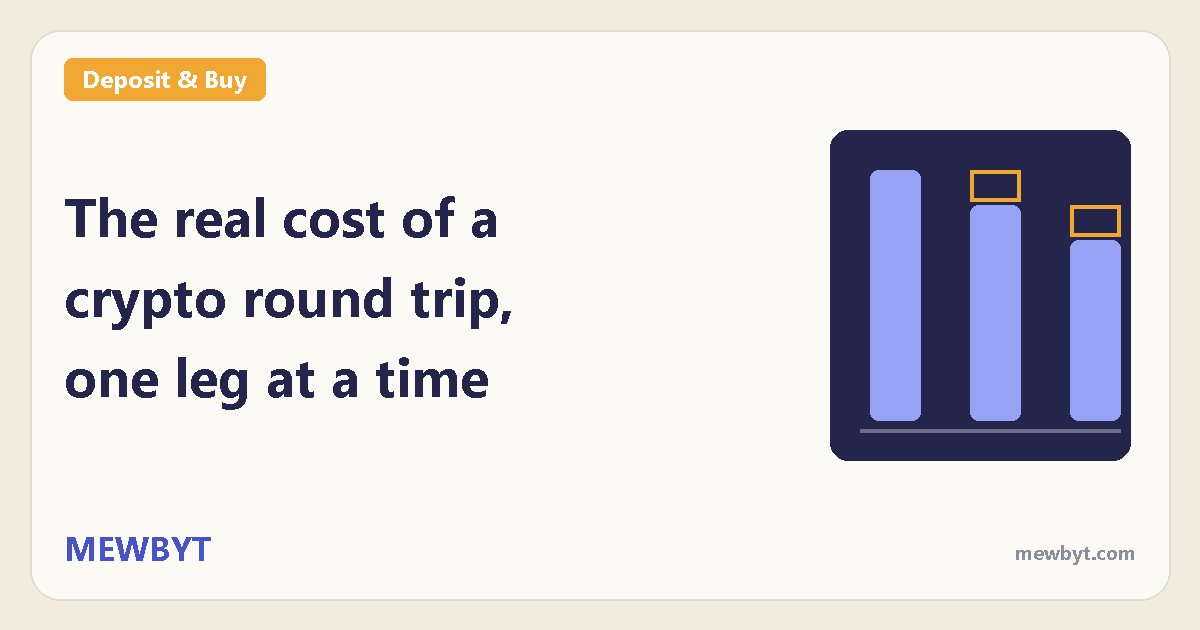
Say the market values USDT at 1.000 dollar, and you start with 1,000 dollars. The figures that follow are illustrative, picked to show the shape of the costs rather than to quote any real merchant. You buy on P2P from a merchant selling at 1.005, which gets you 995.02 USDT. You send it once on-chain and pay a network fee of 1 USDT, leaving 994.02. Later you sell to a merchant buying at 0.995 and receive 989.05 dollars. The price of USDT never moved, and the round trip still cost you about 11 dollars, a little over 1%.
Your own numbers will differ, sometimes smaller and sometimes larger, but the structure holds: three small bites, and every round trip takes all three again. None of them is dramatic on its own. Together they decide how far behind the starting line you begin.
Leg one: the buying spread hides in the rate
A P2P merchant's price is not a favor. Between the rate they sell at and the rate they buy at sits their margin, and that gap is the spread. It never appears as a fee on any screen; it lives inside the unit price you accept, which is exactly why it is so easy to overlook. Checking it takes seconds: look up the day's exchange rate for your currency against the dollar, set it next to the merchant's price, and the premium you are paying is right there.
Prices differ between merchants and between hours of the day, and scrolling one more page of listings is often where the saving is. Just do not chase a slightly better rate into a merchant who shows warning signs. How to judge a counterparty is in our guide to choosing a P2P merchant, and no spread saving is worth a frozen bank account.
Leg two is the network fee, and it is per transfer
Whenever coins move between an exchange and a wallet, or between two exchanges, the network charges a fee. It is set per transfer, not per dollar, so sending 10,000 costs the same as sending 100. So the rule writes itself: fewer moves are better, and many small moves are the most expensive way to do it. Fees vary a lot from one network to another, and the only figure that counts is the one on the withdrawal screen at the moment you send. How to pick a network, and what happens when you pick the wrong one, is covered in our guide to USDT sent on the wrong network.
If you buy and then keep the coins on the same platform to trade, nothing moves on-chain and this leg costs you nothing.
Why the selling spread is a separate cost
Cashing out mirrors buying. The merchant who takes your USDT pays less than the reference rate, and the difference is another bite. What people miss is that the buying spread and the selling spread are not the same number. When the market is under stress, with prices swinging hard or lots of people trying to cash out at once, the selling side can widen noticeably. Needing money in a hurry tends to mean selling when that spread is at its worst, so a cash-out you can plan is worth timing away from those moments.
Large cash-outs bring a different set of questions, about limits, records, and what your bank may ask. Those are in our checklist for a large cash-out.
What to trim and what to leave alone
Worth trimming: compare a few merchants before you order, which takes a minute; cut any on-chain move you do not need; avoid cashing out in the middle of a market panic; and work out trading fees ahead of time with our spot fee calculator.
Not worth trimming: going to an unknown small merchant for a better price, because the counterparty risk dwarfs the saving; choosing an obscure network the receiver does not support to save on the fee, because one mistake costs far more than the fee ever would; and trading privately off the platform to skip a step, which saves nothing and throws away the escrow that protects you.
Two savings habits that backfire
The first is switching merchants constantly to shave a fraction off the price. Comparing is a good habit. Always taking the single cheapest ad on the board is not. The cheapest listings often come from merchants you have never dealt with, and the saving is counted in fractions of a cent per USDT while the risk is counted in frozen accounts. The sensible version is to compare two or three merchants you already trust, not the whole market.
The second is holding USDT and waiting for a better rate to sell. Spreads do move, but sitting on a large stablecoin balance for weeks to catch a better exit brings other exposure: moves in your own currency's exchange rate, and the question of where those coins are held in the meantime. Either can cost more than the spread you were trying to dodge. The boundary is simple: make the trades you were going to do anyway a little cheaper, and do not let the savings change what you do.
The three legs side by side
| Cost | Where it shows up | What sets its size | How much you control it |
|---|---|---|---|
| Buying spread | Inside the unit price | The merchant's rate and the time of day | Partly: compare before you order |
| Network fee | Charged per transfer | The network and how often you move coins | Mostly: move coins less often |
| Selling spread | Inside the price you receive | Market conditions when you sell | Partly: avoid the worst moments |
None of this will ruin anyone. What it does decide is where you start each time, and a little saved on every round trip turns into a gap you can actually see after a year.